
Every thought flies across the Sacro Bosco - Park of the Monsters - Bomarzo, Lazio
by Daniele Marzeddu Northampton 5th March, 2026
Photography by Daniele Marzeddu

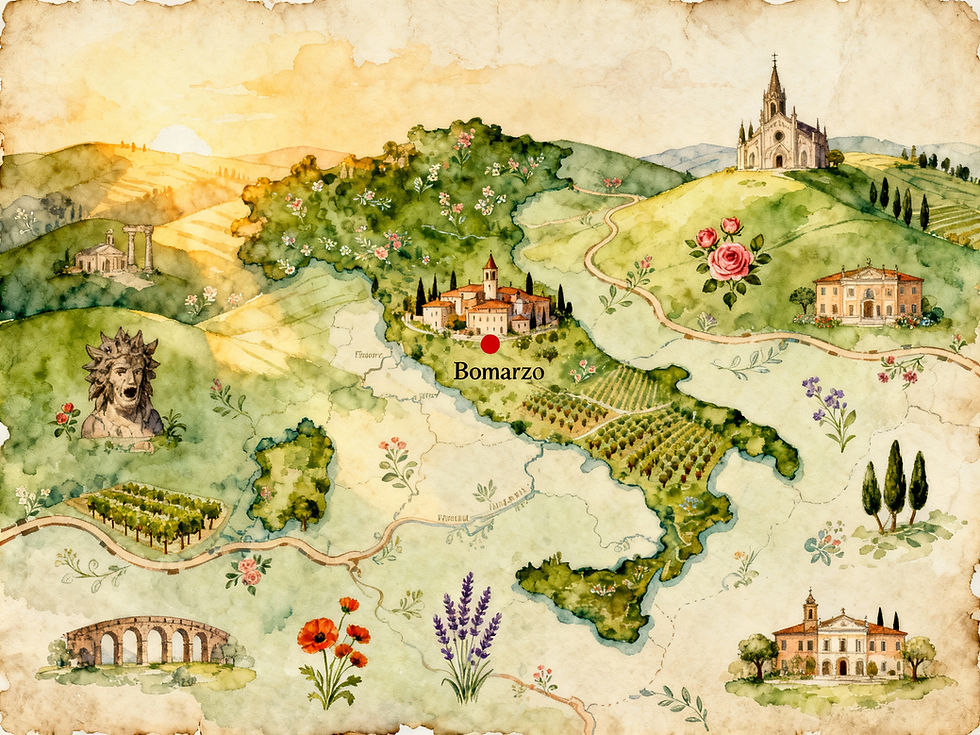
In central Italy, in the lower valley of the River Tiber, lies Bomarzo, a small town erected on a rocky spur that originated from lava flows of the surrounding ancient volcanoes. In all likelihood, the town's name originates from Polymartium, which was first mentioned in Paulus Diaconus’ masterpiece Historia Langobardorum (History of Lombards), written in the late decades of the 8th century. Its etymological name "polis martium", “city of Mars,” would suggest it is of Roman origin. However, although there is no archaeological evidence for a Roman foundation of the primary infrastructure, the presence of a brickmaking factory owned by Emperor Marcus Aurelius’s mother Domitia Calvilla may confirm this hypothesis.
I first heard of this town in my Art history course when I was attending the Grammar School in Venice: during one of his intriguing lessons, professor Piergiorgio would delve into the extraordinary cultural heritage left by the Roman-Greek civilisation on a land that had already hosted even more ancient populations before then. The whole classroom would be hypnotised by his mastery at explaining the profound connections between nature, philosophy and the mysterious ways on how mankind would mould the world around them.

Thus, at the beginning of the autumn, inspired by the willingness to discover an unspoiled part of Italy, I went to Viterbo, the capital city of this broad subregion of northern Lazio named Tuscia: this Latin word was originally synonymous with Etruria, the territory inhabited by the Etruscans (also called Tusci). In ancient times, there used to be numerous sacred woods all over central Italy and, over the classic era, the sacred place par excellence was the forest, a natural space radiant with life, fruit, wood for heating and medicinal herbs. Sunlight would hardly penetrate through tree leaves, transforming the landscape with ever-changing light and shadows: for that reason, the forest might have often been perceived as fearsome, dangerous, and a refuge for fantastic beasts, where it was easy to get lost.
It was also the favourite abode of spirits, fauns, satyrs, nymphs, and gods of nature, sometimes benevolent, sometimes hostile: hence, in order to ingratiate them it would become necessary to pay homage to them with food, fragrant herbs, prayers, dances and songs, or votive offerings left on stones hidden in secret places. The voice of Nature is particularly intense in the undergrowth, where time seems to float still in the air with the human soul being able to get connected with deities. Over time, forests began to be equipped with stone altars and statues, subsequently getting to the ultimate evolution of the Etruscan architectural heritage’s building, the temple.
Women gatherers were the first to come into contact with this magical world, becoming its first priestesses: shielded by the gentle and safe protection of tree branches, rituals and ceremonies started to take place in hidden and protected clearings. Since the forest was home to otherworldly creatures, it was necessary to ask the forest deities for permission to hunt or cut wood. It was a time when Europe was covered with natural forests and many peoples deliberately chose them as sacred places of worship, enriched with beneficial energies.

In fact, trees and forests were central to the religious beliefs of the Greeks, Romans and Germanic populations: chiefly among the Celts, trees were symbols and instruments of initiatory knowledge and spiritual teachings. The Druids would carry out their sacred duties in the forest, being this a source of essential ingredients for their magical and medicinal potions.
So that Pliny the Elder in his work Naturalis Historia narrates:
“Due to their excessive invasiveness in growing, oak trees even occupy the coastline and, because of the waves that dig into the earth beneath them or the wind that pushes them, they break away, taking with them large islands formed by the intertwining of their roots: they remain upright, balanced, and move around floating. The structure of the large branches, similar to sailing rigging, has often caused havoc to our fleets when the waves pushed these islets, almost on purpose, against the bows of ships anchored at night; and the ships, unable to extricate themselves, engaged in naval combat against plants. Also in the northern regions, the Hercynian forest with its enormous oaks (left untouched by the passage of time and originating together with the world) is by far the most astonishing phenomenon due to its almost immortal condition. Without mentioning other facts that would not sound credible, it is true that the roots, pushing against each other and pushing back, raise hills; or, if the ground does not follow them as they move, they bend up to the height of the branches and form contrasting arches like wide-open portals, allowing squadrons of cavalry to pass through.”
With the emergence of Christianity, though, forests and woods gradually began to lose all their sacredness. The Roman Catholic Church and its preachers worked hard to Christianise the so-called pagan peoples. Despite its increasing power in evangelising them under the new belief, priests would face many hurdles in their attempts to convert those populations into Christians. As a matter of fact, their cults and beliefs were based on a very profound relationship with natural phenomena such as trees, water springs and sacred stones.

On the contrary, the cultural base of the Judeo-Christian theology provides for everything to be made by God for Man. Under this view of things, what used to be deemed sacred began to be viewed as of scarce significance, so that almost all spiritual meaning was removed from nature, almost as if it had turned an obstacle to its exploitation and antithetical to the anthropomorphic conception of divinity.
The “Sacro Bosco” (Sacred Wood) of Bomarzo stretches over a wide three-hectare park, featuring a path lined with large basalt statues, surreal buildings, inscriptions and riddles that constantly surprise and disorient visitors. Mermaids, sea monsters, giant turtles, satyrs, sphinxes, dragons, masks, fake tombs and illusionistic games inhabit the Sacred Wood, also known as “Parco dei Mostri” (Park of Monsters) due to the presence of these grotesque sculptures scattered throughout. It is the oldest sculpture park in the modern world.
Its conception and development are the work of Pier Francesco Orsini, lord of Bomarzo until 1581. Born into the wealthy Orsini family in 1523, Pier Francesco lived a life of privilege and power, although he did not have a completely trouble-free existence. Dubbed “Vicino”, his nickname had been given to him by his parents as a token of gratitude to Pier Francesco Vicino I (Pier Francesco’s mother's maternal grandfather), from whom his father Gian Corrado had inherited the fiefdom of Bomarzo - passed down exclusively through the male line - upon his death in 1503.

The House of Orsini is an Italian noble family that was one of the most prominent princely families of medieval Italy and Renaissance Rome, whose members even include five influential popes: Benedict XIII, Stephen II, Paul I, Celestine III and Nicholas III. Pier Francesco, as a mercenary commander for Pope Paul III, closely witnessed the turbulence and brutality of 16th-century Italy. Similarly, his private life was shaken quite dramatically after the death of his beloved wife Giulia Farnese, in 1560. Heartbroken, Orsini withdrew from public life to his estate in Bomarzo, where he channelled his sorrow and imagination into creating something extraordinary.

Those were the years of the Counter Reformation, where the Catholic Church reacted to the Protestant Reformation: in that historical vision of the world, Vicino, in order to conceal the true alchemical nature of the work and avoid arousing suspicion, named his Bosco the Villa delle Meraviglie “Villa of Wonders.” Through a series of references to mythology and enigmas, its creator aimed to surprise his visitors by transporting them into an enchanted world.
The Villa was dedicated to Giulia, as indicated by an inscription affixed to the temple that has since disappeared (“to the happy memory of the illustrious Giulia Farnese”). In fact, he longed to have the new garden built Sol per sfogare il core “to let the heart steam off.” The imaginative nobleman commissioned architect Pirro Ligorio, renowned for completing St. Peter's Basilica after Michelangelo's death, to work on the design of the grounds, whereas the whole statuary seems to be attributed to Simone Moschino, a sculptor who had mainly worked in the Grand Duchy of Tuscany.

Pier Francesco had the rocks carved on site, bringing them to life and giving them shapes - sometimes menacing and sometimes persuasive - of dreamlike creatures. Ligorio found his main source of inspiration in Francesco Colonna's literary masterpiece Hypnerotomachia Poliphili (1499), in which is narrated the story of the death of Polia, beloved woman of Poliphilo. Unlike most Italian gardens, Pier Francesco and his landscape experts left the trees and shrubs undisturbed, strewing his magical place with unusual and grotesque creatures instead of ornate fountains, neat hedgerows and intricately sculpted classical gods and goddesses.
After Orsini passed away, the Sacro Bosco was abandoned to the elements. Public interest was only reignited several centuries later after Salvador Dalí went to Bomarzo. In 1948, enchanted by Vicino’s gargantuan, now moss-covered creatures, the Catalan artist wanted to make a short film about it, and the monsters are referenced in his 1964 painting The Temptation of Saint Anthony. Following this revived interest in the Bosco Sacro, other artists decided to create parks and gardens in the Tuscia region as places of self-initiation into creative action, open to transgressions, where works arise from the complexity of interference.
I got deliberately lost in the Bosco, losing any sense of space or time, catapulted in a dimension of total reverie. And it is true, Ogni pensiero vola “Every thought flies away”, as the iconic mouth of the park ogre shouts silently but loudly.

Daniele Marzeddu

Bibliography
Th. Ashby, La Campagna Romana nell’età classica, Longanesi, Milano, 1927
A. Carandini, Hortensia – Orti e frutteti intorno a Roma, in Misurare la terra: centuriazione e coloni nel mondo romano; materiali da Roma e suburbio, 1985, Modena.
F. Coarelli, L’urbs e il suburbio, in A. Giardina (a cura di) Società Romana ed impero tardoantico II, 1986, Laterza, Bari.
L. Spera, Il paesaggio suburbano di Roma dall’antichità al Medioevo: il comprensorio tra le vie Latina e Ardeatina dalle Mura di Aureliano al III miglio, L’Erma di Bretschneider, Roma, 1999.
Biography
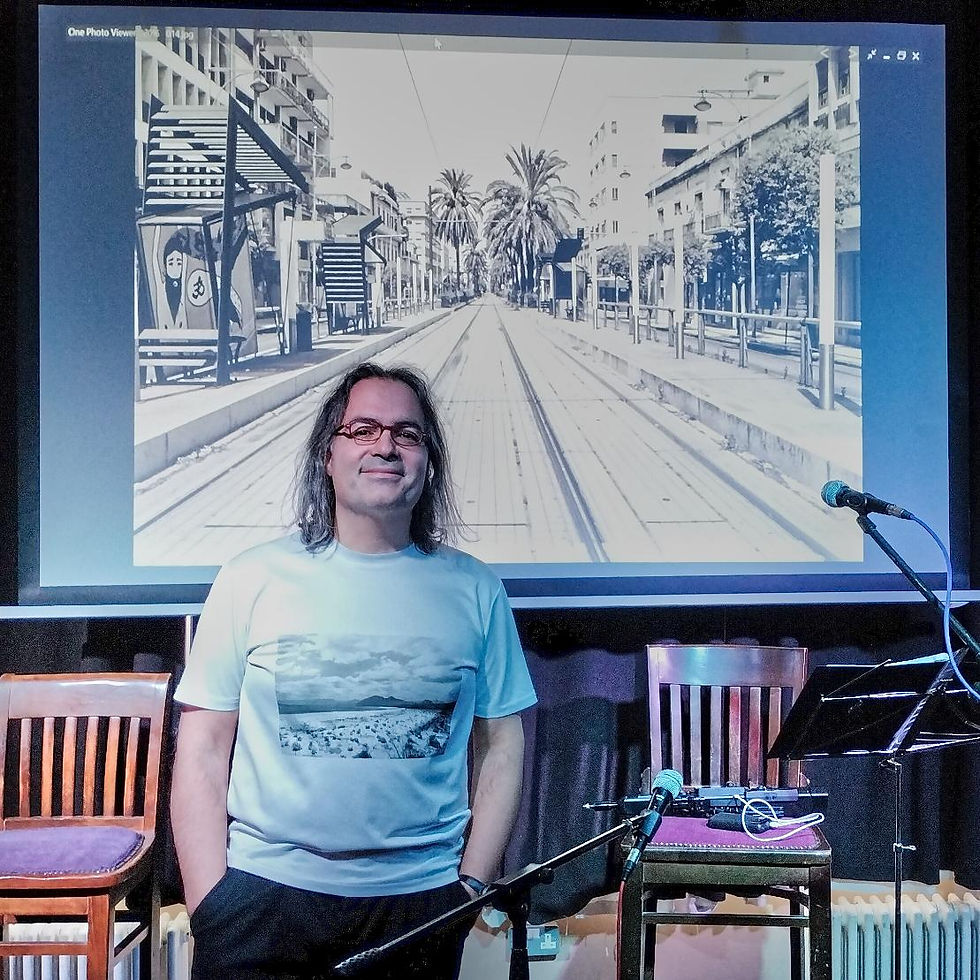
A Master of Arts in Cultural heritage from the University of Venice, Daniele Marzeddu is an award-winning photographer, filmmaker, writer and saxophonist, boasting international publications in the areas of culture, history and languages. His interests range from the legacy of cultural memory to the intersections of music and contemporary life, from the collective unconscious to multiculturalism. He has participated in library talks and workshops across the UK and Italy to discuss his photographic processes and historical research. His most recent works include:
Return to Sea and Sardinia (2021): A documentary film and multimedia project that retraces D.H. Lawrence's 1921 journey through Sardinia. It explores the island's contemporary culture and identity exactly a century after Lawrence's book was published. Films of Sicily and Sardinia (2024): A dual-language book published by Edizioni Low of Piacenza. The work continues his exploration of the trail of D.H. Lawrence through photography and literature. He is currently working on the completion of his second book titled This is Britannia. Portraits of Post-Brexit Britain, which will be released in May 2026 by Edizioni Low. The Photography Portfolio of DANIELE MARZEDDU pdf https://drive.google.com/file/d/1G3DYKZRjmetDnKY07-iD2G-dNS-vP8xM/view?usp=gmail
Further reading: about Daniele Marzeddu and Nick Ceramella https://www.artculturetourism.co.uk/post/act-event-insights-into-d-h-lawrence-s-sardinia-book-launch-at-lakeside-arts-universityof-nottingham
Useful Tourism Links: Official Website/Booking: parcodeimostri.com is the primary source for tickets, opening hours, and official information.
Contact Information: For inquiries, the email address is info@parcodeimostri.com, and the telephone number is +39 761 924029.
Location: The park is located in the municipality of Bomarzo, near the Lazio-Umbria border.
Entrance Fee: Typically around 13 euros for adults and 8 euros for children.
This article is published by Marysia Zipser, Founder, Ambassador of Art Culture Tourism & Keynote Speaker, Beeston, Nottingham. https://www.artculturetourism.co.uk/ https://www.artculturetourism.co.uk/blog E: artculturetourism@gmail.com
Please feel free to write your feedback, remarks/reactions to Daniele in the Comments box below, to which he will respond, and to share/forward this article/blog link via email to friends, colleagues and to socials as you wish. Thank you.
I have been inspired so deeply by Daniele's article I feel a real pull to visit for myself some day. This is such a magical place, that comes through to me. Daniele brings the history and folklore to life! I feel a draw to reread.
A wonderful article and a special glimpse into the magical Sacro Bosco. 😍
Ciao Daniele, Sempre più interessanti le cose che fai , scopri e fai conoscere luoghi particolari grazie e complimenti ...
Reading this piece about the mysterious Sacro Bosco di Bomarzo, I felt as though I’d been invited to a Renaissance garden party hosted by monsters, and frankly, I’m delighted I RSVP’d.
The article captures the wonderfully odd spirit of this place: a 16th-century woodland where dragons, elephants, giants and the occasional philosophical inscription lurk among the trees. Commissioned in the 1500s by Pier Francesco Orsini, the park was never meant to be a tidy, symmetrical garden like the others of its time, it was designed to astonish, puzzle and perhaps mildly unsettle visitors. Mission accomplished.
What I especially enjoyed in the article is how it embraces the park’s delicious weirdness. Where else can you wander through a forest and suddenly…