
Kenilworth Castle: Then and Now (Or How We Became the Exhibits)
by Sungsoo Kim
Leicestershire
20th March 2026
A meditation on revisiting the past, minus the screaming children and plus a few extra creaking joints “Was it always this quiet?”
That was the question I asked my wife last spring as we stood in the pale sunshine at Kenilworth Castle. The silence felt almost theatrical. No teenagers arguing over whose turn it was to hold the map. No urgent diplomatic negotiations about the strategic timing of ice cream. No frantic parental scanning of battlements for children about to re-enact a medieval siege.
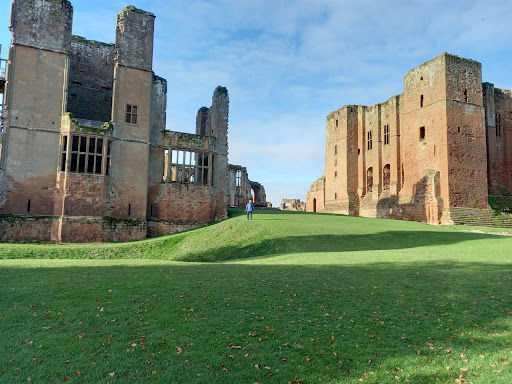
Last Spring I went to Kenilworth Castle with my wife.
Just the two of us. And nine centuries of history.
Eleven years earlier, in May 2014, quiet was the last word anyone would have used. We had come with our two secondary-school-aged children and met dear friends and their equally energetic offspring. The castle grounds became a historical adventure park crossed with a mild endurance test. The children tore around the ruins like caffeinated squirrels while we adults attempted conversation in that uniquely parental dialect: half architectural appreciation, half emergency coordination.
“Yes, fascinating Norman masonry,” one of us would say, while simultaneously counting heads. “One, two, three, where’s Jonathan?”
There was a picnic. Someone dropped a sandwich. A wasp intervened with territorial ambition. By the time we left, we were sun-warmed, slightly frazzled, and absolutely exhausted. It was chaotic, noisy, and completely perfect.
Last spring, we returned alone.
The Castle That Time (Mostly) Forgot
Kenilworth Castle is no ordinary ruin. Founded around 1120, it has survived nearly 900 years of ambition, warfare, romance, and reinvention. It served as a royal fortress and was significantly strengthened under King John, best remembered for losing French territories and reluctantly signing Magna Carta, which suggests fortification may have been a coping strategy.
But the castle’s most theatrical chapter belongs to Robert Dudley, Earl of Leicester. In 1575, he staged what remains one of history’s grandest romantic gestures. For nineteen days he entertained Queen Elizabeth I with fireworks, masques, hunting parties, theatrical performances, and lavish feasts, all in the hope of winning her hand.

A reconstruction drawing by Ivan Lapper of Queen Elizabeth I being welcomed at Kenilworth Castle
by Robert Dudley in July 1575
Queen Elizabeth I © National Portrait Gallery Robert Dudley, 1st Earl of Leicester, Collection of Waddesdon Manor
In modern terms, the cost would amount to millions.
The outcome? Elizabeth remained gloriously unmarried.
One imagines Dudley surveying the final embers of his fireworks display and quietly reconsidering his life choices. Perhaps flowers would have sufficed. Or at least a smaller banquet.
Later, during the English Civil War, Parliament ordered the castle partially demolished to prevent it from being used as a fortress again. Towers were reduced, walls deliberately weakened. Yet in diminishing its military power, history enhanced its romance. Ruins, it seems, age rather well.
Kenilworth stands today not as a monument to victory, but to endurance.
The Return of the Empty-Nesters
Last spring’s visit carried a different weight.
Our children have grown up, left home, and built lives of their own. They appear reasonably competent adults (though we suspect instant noodles remain a dietary staple). They no longer require supervision on steep staircases or arbitration over map-reading rights.
Our friends, meanwhile, were unable to join us due to health challenges. Time, it turns out, does not merely pass, it rearranges the guest list.
So, there we were: two people of a certain age, standing before a medieval ruin and inevitably contemplating mortality. It is something of a surprise that English Heritage does not charge a supplement for existential reflection. The setting practically invites it.
And yet something unexpected happened. Without the joyful chaos of child-wrangling, we actually saw the castle.

We noticed the arrow loops carved into the gatehouse walls, narrow slits through which defenders once aimed crossbows. We paused on stone steps worn hollow by centuries of feet. We lingered in the cool, shadowed chambers that once served as prisons, suddenly aware that history was not always pageantry and spectacle.
Freed from distraction, the castle began to feel less like a backdrop and more like a conversation partner.
A Change in Perspective
Eleven years ago, our priorities were pragmatic: sun cream, sandwiches, safety. We marvelled at the scale of the ruins, certainly, but through a haze of logistics. Photographs were snapped hurriedly before someone disappeared behind a tower. Architectural appreciation was conducted between snack negotiations.
Last spring, there was no rush.
We sat on the grass without anyone announcing an urgent need for the toilet. We debated whether Robert Dudley was genuinely romantic or simply staging the Tudor equivalent of a grand publicity stunt. (The consensus: both.) We stood still long enough to hear the wind moving through broken windows.

Looking over to Leicester's gatehouse, built by Robert Dudley in a deliberately anachronistic style. @English Heritage
At one point, my wife climbed to the viewing platform and gazed toward the horizon with unmistakable poise.
“Feeling like Queen Elizabeth?” I asked.
Her middle name, I should note, is Elizabeth.
She smirked. “More like a lady-in-waiting.”
“Does that make me your knight in shining armour?”
“No,” she replied serenely. “You’re the horse pulling the carriage.”
After nearly thirty years of marriage, I have learned that some sieges are unwinnable. The Siege of Kenilworth in 1266 lasted six months. My attempt to reclaim dignity lasted approximately four seconds.
Negotiations continue. I am currently lobbying for an upgrade to “loyal steed.”
What Changes, What Doesn’t
The castle stands much as it did in 2014, having already been a ruin for centuries, it is firmly committed to the aesthetic. But we have changed.
Kenilworth Castle @English Heritage
Then, we were harassed parents documenting childhood before it slipped through our fingers. Now, we are reflective empty-nesters, aware that childhood has indeed slipped by, but has been replaced by something steadier and deeper.
Our conversations have evolved.
Once: “Have you seen where Jonathan put his shoe?”
Now: “Do you think we should have brought warmer coats?”
We move more slowly. We notice more. We disagree less urgently and laugh more easily. Time has worn us, certainly, but it has also smoothed certain edges.
There is a quiet intimacy that comes with shared history. We can stand in silence and still understand one another. We can look at a patch of grass and recall precisely which child tripped there eleven years ago. We can remember the wasp incident of 2014 in absurd detail.
The castle seems to ask, gently: “How have you lived these past eleven years?”
The honest answer? Imperfectly. Sometimes anxiously. Occasionally foolishly. But always together.
Like the castle, we are missing a few pieces. Like the castle, we show the marks of weather and time. But we remain standing.
Then and Now
Then and now invites reflection on continuity and change, and Kenilworth embodies both.
It was once a symbol of military strength; now it is a place of school trips and thoughtful wanderers. It witnessed extravagant romance and brutal conflict. It was deliberately broken, yet still commands attention centuries later.
In 2014, it framed the noise and laughter of our family in motion. Last spring, it framed something quieter: two people measuring time not by school terms but by anniversaries and health check-ups.
The transformation is subtle but profound.
“When we come back with the grand kids,” I said as we sat on the grass, “you’ll be the queen and I’ll still be the horse.”
“Horses are pushing it,” she replied. “I’ll promote you to knight if you behave.”
Promotion, it seems, remains performance-based.
Looking Ahead
In another eleven years, health and joints permitting, perhaps we will return again. Maybe with grandchildren racing across the lawns, restoring joyful chaos to the ruins. Maybe just the two of us, moving more cautiously over uneven stones.
Perhaps we will sit on a bench and mutter about how young people today do not appreciate proper masonry. Perhaps we will marvel that we once climbed those stairs without hesitation.
Whatever the scene, one thing will remain unchanged: we will walk together.
Kenilworth Castle has endured sieges, demolition, neglect, and the English weather. It has survived ambition and disappointment, glory and ruin. If it can persist for nine centuries, we can manage a few more decades.

The inner court as seen from the base court; left to right are the 16th-century Leicester's building; Gaunt's 14th-century Oriel tower and great hall; and Clinton's 12th-century great keep. Wikipedia
Time does not pause. Children grow. Friends face illness. Knees protest on steep steps. But memory settles into stone and into the heart.
The silence that surprised us last spring was not emptiness. It was fullness of another kind, a space in which reflection could settle. The laughter of 2014 has not disappeared; it has simply become part of the structure, layered invisibly into the walls.
As we left, I glanced back at the broken towers silhouetted against the sky. They looked as they always have: weathered, incomplete, dignified.
Then I caught up with my wife.
After all, even a provisional knight must keep pace.
And next time, I sincerely hope someone else brings the picnic. That wasp from 2014 still lingers in family legend.

In May 2014, I went to Kenilworth Castle with my family and friends.
Sungsoo Kim
Biography

Sungsoo Kim was born in Seoul in 1960. He graduated from Technical High School and National Railroad College in Korea. From 1981 to 1989 he worked as a railway engineer, resigning on 4 February 1989, the day of Ham Sok-hon’s death (known as 'Korean Gandhi'). In 1990 he came to the UK to study history, completing BA and MA at Essex University and PhD at Sheffield University. After returning to Korea in 2000, he served on the Truth and Reconciliation Commission, editing The Voice of the People and led Transparency International-Korea.
Sungsoo Kim in the centre
Now he lives in Britain with his English wife and two children, and has authored several books in Korean and English. He writes on British and world history for Korean papers as the UK Correspondent.
Useful tourism links:
This article is published by Marysia Zipser, Founder, Ambassador of Art Culture Tourism & Keynote Speaker, Beeston, Nottingham. https://www.artculturetourism.co.uk/ https://www.artculturetourism.co.uk/blog E: artculturetourism@gmail.com
Please feel free to write your feedback, remarks/reactions to Sungsoo in the Comments box below, to which he will respond, and to share/forward this article/blog link via email to friends, colleagues and to socials as you wish. Thank you.
What an inspiring read! A wonderfully affectionate account of a visit to Kenilworth Castle overlaid with memories of a family outing with two energetic offspring to meet with good friends and enjoy time together. The golden memories are beautifully conveyed, drawing the reader in to observe life at its very best in both the past memories and more recent ones. Give me more please Sungsoo!"