
Scotland: Memories Framed in Light of Poetry

Updated: May 28
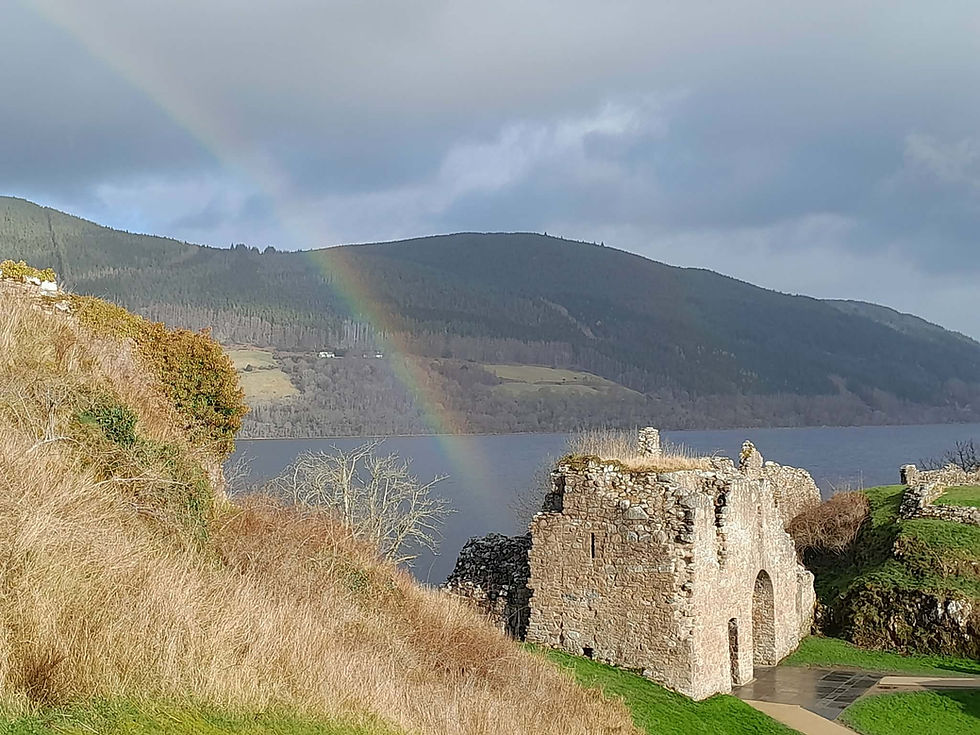
Urquhart Castle. Photo credit: Simona Prilogan
by Simona Prilogan
London 29 May 2026
“My heart's in the Highlands, my heart is not here,
My heart's in the Highlands, a-chasing the deer;
Chasing the wild-deer, and following the roe,
My heart's in the Highlands, wherever I go.
Farewell to the Highlands, farewell to the North,
The birth-place of Valour, the country of Worth ;
Wherever I wander, wherever I rove,
The hills of the Highlands for ever I love.
Farewell to the mountains, high-cover'd with snow,
Farewell to the straths and green vallies below;
Farewell to the forests and wild-hanging woods,
Farewell to the torrents and loud-pouring floods.
My heart's in the Highlands, my heart is not here,
My heart's in the Highlands, a-chasing the deer;
Chasing the wild-deer, and following the roe,
My heart's in the Highlands, wherever I go.”
My Heart's In The Highlands - Robert Burns
In 1789, the national poet of Scotland, Robert Burns, wrote verses that still travel across centuries and hearts. This year, those words met me in the utterly beautiful village of Alloway, where I travelled in January to learn more about Scotland’s poetry and the vibrant hues of its landscapes translated through the pen of Burns.
As a poet myself, deeply in love with rhyme and rhythm, with forests and rivers, mountains and valleys, I felt an immediate sense of belonging when I stepped through the doors of the Robert Burns Birthplace Museum, cared for by the National Trust for Scotland. The moment felt almost mystical, as though the cheerful spirit of poetry had placed a benevolent hand upon my shoulders and recognised a kindred heart: one that sings of feelings, nostalgia, nature’s beauty, and love at its core.
Within the serenity of that cosy museum, home to more than 5,000 Burns artefacts, I wandered among handwritten manuscripts, letters, and personal belongings of the poet. There, I learned about the craft of Burns and the world that shaped him: the hardships and dignity of rural Scottish life in the eighteenth century, the farming family in which he grew up, and the social realities that influenced his themes of equality, love, labour, and humanity. Burns famously elevated the Scots language into literature at a time when it was often dismissed as merely a dialect. Through poems and songs such as “Auld Lang Syne,” now sung around the world each New Year, he ensured that the voices of ordinary people would be heard far beyond Scotland’s fields and cottages.

Oldest known engraving of Burns Cottage 1805. Artist unknown. Public Domain.
The museum itself stands beside another legendary place: Burns Cottage, the humble thatched house where Burns was born in 1759. Nearby lies the atmospheric Brig o’ Doon, immortalised in his famous narrative poem Tam o’ Shanter, a tale woven with witches, storms, and Scottish folklore. Walking through Alloway, it is easy to feel that poetry here is not confined to books; it lingers in the air, on the riverbanks, and on the old stones.
After that day of making acquaintance with the living memory of Robert Burns, my journey continued in Glasgow, where I attended the Centre for Robert Burns Studies Conference at the University of Glasgow. The event, organised in collaboration with the Robert Burns Birthplace Museum, took place at the Mazumdar-Shaw Advanced Research Centre. The conference explored many dimensions of Burns’s life, work, and afterlife: from new literary research to reflections on how his poetry continues to shape Scottish cultural identity.
Alongside inspiring lectures and specially named talks, some performances reminded us that Burns is not only a subject of scholarship but also a living tradition. Artists such as Ellie Beaton, winner of the BBC Radio Scotland Young Traditional Musician of the Year in 2025, brought the poet’s songs to life. In that space of music and conversation, it became clear that Burns’s legacy is not frozen in history. It breathes through voices, melodies, and gatherings across Scotland and far beyond.
Every year, this legacy is celebrated on Burns Night, when people across the world gather to share poetry, music, and the traditional Burns supper, complete with haggis, whisky, and recitations of Burns’s works. The evening is both festive and reverent, honouring the poet who wrote so memorably of friendship, love, and human dignity.
Beyond the lectures and performances, what touched me most was something less formal yet deeply meaningful. I witnessed how Burns’s poetry continues to bind people together in friendship, reflection, and joy. As someone who has lived in London for a while, often enclosed in the quiet loneliness that a large city can bring, I suddenly discovered a different rhythm of life. In Scotland, I found that striking up a conversation with a stranger is valued and embraced by many people. That simple openness felt like poetry in itself. And I loved it.
Robert Burns Conference, University of Glasgow, 17 January 2026
My life feels like a long poem, composed of many stanzas. Love, hope, kindness, and faith written across its pages. While I was still in Glasgow, I continued writing my own verses of life, searching for the flow of rivers, the whispers of wind, and the music hidden in forests. Poetry, after all, often begins with listening.
The morning after the conference, I took a train from Glasgow Central to Dumbarton. It was a winter journey, yet January itself seemed to compose beautiful stanzas in the poetry of the day. The town rests where the River Leven meets the wide waters of the River Clyde, and above it rises the dramatic silhouette of Dumbarton Castle.
Wandering through the ancient ruins of the castle, I encountered the echoes of an old song, “Dumbarton’s Drums,” a traditional Scottish love song dating back to the eighteenth century. Like many folk songs of Scotland, it travelled through generations by word of mouth before being written down. It later became associated with the collecting work of Robert Burns, who preserved and adapted many traditional Scottish melodies and lyrics. Burns believed that folk songs carried the emotional history of a people. Their loves, losses, and everyday joy. And he carefully gathered them so they would not disappear.
The song I found seemed to float naturally across the landscape:
“Dumbarton’s drums they sound so bonnie
When they remind me of my Johnny,
What fond delight can steal upon me
When Johnny kneels and kisses me.
Across the fields of bounding heather
Dumbarton tolls the hour of pleasure,
,A song of love that has no measure
When Johnny kneels and sings to me.
’Tis he alone that can delight me,
His graceful eye, it doth invite me,
And when his tender arms enfold me
The blackest night turns bright for me.
My love, he is a handsome laddie,
And though he is Dumbarton’s caddie,
Someday I’ll be a captain’s lady
When Johnny vows his love to me.”
Standing there, nostalgic and singing softly to myself, I felt the landscape answer the melody. Beneath my feet rose the great rock on which the castle stands, a volcanic plug rising about 73 metres above the Clyde, a natural fortress formed by ancient fire long before any human walls were built.
Climbing the more than 600 steps that wind up the rock, I felt my rhymes grow lighter and more hopeful. Perhaps it was the wind sweeping over the battlements, or the vastness of the surrounding landscape. Perhaps it was simply the voice of the river itself. The Clyde seemed to murmur stories as sunlight danced upon its waters.
It spoke first of ancient kingdoms. Long before medieval Scotland took shape, Dumbarton Rock was the heart of the Kingdom of Strathclyde, a powerful Brittonic realm whose fortress was known as Alt Clut, meaning “Rock of the Clyde.” For centuries, this stronghold guarded the western approaches to Scotland.
Then came the Vikings. In the year 870, Norse raiders from Ireland launched the dramatic Siege of Dumbarton. After a long blockade that cut off the fortress’s water supply, the defenders were forced to surrender. Many captives were taken away across the sea, and the fall of the fortress marked the decline of the old kingdom.
In the centuries that followed, the castle remained strategically vital. During the Middle Ages, it served as a royal stronghold controlling the Clyde and monitored ships travelling inland toward Glasgow. Its cliffs made it extraordinarily difficult to attack; the rock itself seemed to have been designed by nature to guard the river.
The castle even brushed against the life of Mary, Queen of Scots. In 1548, when she was still a child, she stayed within its walls before being sent to France for safety during Scotland’s turbulent conflicts with England. For a brief moment, the dramatic rock became a cradle of royal history.
Yet the river did not speak only of history. As the sunlight shimmered like something out of a fairy tale, the Clyde whispered a legend.
They say the castle is haunted by a mysterious White Lady, a pale figure who appears along the stairways or the battlements when the wind is quiet. According to local lore, she was once a noblewoman who died tragically during one of the castle’s violent conflicts. Some believe she still waits for a lover who never returned from war. Over the years, guards and visitors have claimed to glimpse a silent white shape moving along the stone walls before vanishing into the mist.
Listening to this fascinating storyteller, the river itself, I smiled. The Clyde flowed calmly beside the great rock rising almost straight from the landscape, a fortress built first by nature and only later by human hands.
And there, on that dramatic height above water and wind, another stanza peacefully formed within the long poem of my life: a peaceful Sunday morning, blessed by sunlight and carried softly by the ancient sagas of Dumbarton.
Scenes around Dumbarton Castle
I enjoyed that first journey so deeply that I made a promise to myself: I would return to Scotland and discover more of its culture, its astonishing landscapes, and its art. The country seemed to speak not only through history and poetry, but through wind, rivers, and mountains.
So, when I returned home to London, I was already planning my next chapter. Before long, I booked a flight to Inverness for February. The gateway to the Highlands and a city often called the cultural capital of the north.
Travelling there felt like the beginning of a new stanza in my life’s poem. On the day I departed, I wrote these lines:
The calling of forests is signing my cup
Of longing and dreaming; my pipedreaming tea.
I pause for a moment and load yearning up
On this lovely morning of midwinter’s quay.
The glimpses of wonder are penning a draft:
Come on, pack your feelings and catch up the bliss
Away on the green lands where grace meets the skies
And winds are regarding their blue-loving kiss.
My heart speaks a language of sunrises’ peace,
With rainbows’ embracements while waltzing away,
Green rhymes in a tender poem of pipedreams,
Somewhere in the Highlands, in splendid array.
When I arrived in Inverness, rain was gently falling across the city. Yet the air felt incredibly fresh and invigorating, as though the Highlands themselves were breathing life into my thoughts. Even the rain seemed musical, tapping softly against the streets and the waters of the nearby River Ness.
The next day, I travelled to the dramatic ruins of Urquhart Castle, one of Scotland’s most iconic historic sites. The castle stands proudly beside the mysterious waters of Loch Ness, and its history stretches back nearly a thousand years. Built in the thirteenth century, it played an important role during the turbulent Wars of Scottish Independence. Over the centuries, the fortress changed hands many times, witnessing sieges, battles, and royal intrigue before eventually being destroyed in 1692 to prevent its use by Jacobite forces.
But history is only part of its story. Loch Ness itself is home to one of Scotland’s most famous legends: the mysterious creature known as the Loch Ness Monster, affectionately called Nessie. According to folklore, sightings of a strange water beast date back to the sixth century, when Saint Columba reportedly encountered a creature in the River Ness and commanded it to retreat. Ever since, travellers and locals alike have shared stories of dark shapes gliding beneath the loch’s deep waters.
Standing among the castle ruins while clouds and sunlight chased each other across the sky, it was easy to imagine such legends. The rain would fall for a moment, then the sun would break through again, and suddenly the landscape would fill with colour. Throughout the day, I saw rainbow after rainbow arching over the loch, as if the Highlands themselves were painting the sky.
The coach journey to and from the castle was equally breathtaking. The road followed the long curves of Loch Ness, revealing forests, hills, and wide skies that seemed endless. It felt like travelling through a living painting.
That morning when I left Inverness, the rain and sunshine continued their quiet dance. Again, the sky offered me rainbows. Gentle bridges of colour over the Highlands. It was another beautiful Sunday, peaceful and luminous, as though every moment had been carefully brushed onto the canvas of the day.
And in that stillness, I felt grateful, as if God Himself had painted those lovely moments onto the unfolding poem of life.
Scenes around Urquart Castle
On Monday, I planned a longer journey. One that would take me to the far north of the Scottish mainland. From Inverness, I set out toward Thurso, the northernmost town on the mainland of Scotland and indeed of the entire United Kingdom.
I left early, catching the 7 a.m. train, the stillness of the morning wrapping the station in a winter calm. The journey would take about four hours along the famous Far North railway line, one of Britain’s most scenic rail routes. Soon, the train rolled northward, leaving the city behind and entering the wide, ancient landscapes of the Scottish Highlands.
What unfolded outside the window felt almost unreal. The views were spectacular. As if stanza after stanza of a February poem were being written by angels across the land, psalms composed by nature itself. I had brought a few books with me, hoping to read during the journey. Yet I must confess that I barely opened them. The scenery outside was far too captivating; I could not take my eyes from the window.
The train slowly crossed vast stretches of the Highlands. Lands shaped by ancient glaciers and time itself. It passed through the remarkable Flow Country, one of the largest blanket bogs in the world and an internationally important ecosystem. These peatlands store immense amounts of carbon and provide a habitat for rare wildlife such as golden plovers, hen harriers, and red-throated divers. In winter, the land can look quiet and mysterious. Soft browns and golds stretching toward distant hills beneath a wide northern sky.
Further along the route, the train ran beside the shining waters of Dornoch Firth, where sea and land meet in long tidal curves. These northern coasts are known for their wild beauty: salt marshes, sandy shores, and winds that carry the scent of the Atlantic.
The Highlands themselves hold countless legends. One of the most famous comes from the region’s long tradition of folklore about the “second sight”, a mysterious ability said to be possessed by some Highlanders who could glimpse future events or distant happenings in dreams or visions. For centuries, travellers wrote about meeting people who claimed to have this strange gift, and the idea became woven into the cultural mythology of the Highlands.
Another legend often told along the northern routes is that of the selkies, mythical beings who live as seals in the sea but can shed their skins to walk on land as humans. According to coastal folklore, these creatures sometimes fall in love with people from the shore, only to return eventually to the ocean that calls them back. Along Scotland’s northern coasts, where grey seals often appear among the waves, it is easy to imagine how such stories were born.
As the train continued its steady path northward, hills softened into open moorland, and the sky seemed to widen endlessly above the land. Rivers glimmered briefly between patches of heather and peat, while distant mountains rose like solemn guardians of the landscape.
The whole journey felt less like travel and more like witnessing a long, unfolding poem of the Highlands. Lines written in wind, water, and earth. And there I sat by the window, watching those verses pass tenderly by, grateful to read them with my own eyes. And my heart. Falling in love. Again and again, with this land of Gods.
When I finally arrived in Thurso, I felt as though the long poem of my life had reached a particularly beautiful stanza. One written with grace, clarity, and a modest sense of achievement. I was proud of myself for having followed that rhyme of travel so far north, to a place where the land meets the vast northern sea. The town itself was charming and welcoming, but what touched me most were the people. Those I met spoke with warmth and curiosity, and conversations began easily. On the street, near the harbour, or along the riverside. Coming from London, where people often hurry past each other, and silence fills the spaces between strangers, this openness felt almost extraordinary. In Thurso, kindness was simple and natural. And in that kindness, I felt something very human awaken in me again.
Wandering through the town, I followed the quiet path of the River Thurso as it flows smoothly toward the sea. The river seemed to tell stories as it moved. Stories of the past carried softly by the water. For centuries, this river has been famous among anglers as one of the finest salmon rivers in northern Scotland, drawing visitors from around the world. But beyond fishing and landscape, the river also carries whispers of older tales.
Local folklore speaks of water spirits known in Celtic legend as kelpies, mysterious shape shifting beings said to inhabit rivers and lochs. The kelpie often appeared as a beautiful horse near the water’s edge, tempting travellers to climb onto its back before plunging into the depths. Such stories were once told as both warning and wonder, reminding people of the powerful, unpredictable nature of water.
There are also quieter legends tied to the region of Caithness itself. Some tales speak of ancient Norse settlers who arrived here more than a thousand years ago during the Viking Age. The name “Thurso” is believed to come from Old Norse Thorsá, meaning “Thor’s River,” a name connected to Thor, the powerful deity of thunder in Norse mythology. It is fascinating to imagine that the river beside the town may once have been named in honour of a god of storms.
Yet what truly captured my heart was the sea. Thurso lies along the sweeping coast of the Pentland Firth, a stretch of water famous for its powerful tides and deep blue colours. The sea that day was astonishingly blue. So vivid and luminous that it felt almost unreal. The wind seemed to sing softly in A minor, the seabirds circled above as dancers in the sky, and the sunlight broke through the clouds in radiant beams of sacred poetry.
Everything felt serene and luminous, as if the moment itself had been painted with gentle care. Standing there by the shore, I had the strange and beautiful feeling that God might be present in the simple harmony of sea, sky, and wind.
While walking along the coast, I met a gentleman, another traveller. We began talking casually, but soon our conversation drifted toward deeper themes: philosophy, life, and the fragile yet persistent hope we carry for humanity. We spoke about kindness, about belief in people, about the idea that even in a complicated world, there is still goodness waiting to be discovered.
And as we talked, the blue sea stretched endlessly before us, almost as though its vastness echoed our thoughts. The wind carried our words out across the water, and the waves answered pleasantly against the shore.
It was a blessed Monday. Filled with peace, light, and a blessed joy that settled gently in the heart, like a stanza perfectly placed within the unfolding poem of life.
Scenes from Thurso
When the time came to leave Thurso, I boarded the train once again for the long journey south. The return trip to Inverness would take another four hours, but this time the Highlands slowly disappeared beneath the curtain of evening. Night settled over the land, covering the hills, rivers, and distant moors in what felt like a blanket of poetry.
Through the window, I could still see the faint outlines of the Highland landscape. Dark mountains against a deepening sky, lonely lights in faraway villages, and the hushed rhythm of the train carrying me south. The world outside seemed muted and contemplative.
As I sat there, I could not help but recite in my mind the verses of Robert Burns.
“My heart’s in the Highlands, my heart is not here,
My heart’s in the Highlands a-chasing the deer,
A-chasing the wild deer, and following the roe,
My heart’s in the Highlands wherever I go...”
Later, when I returned home to London, the journey did not truly end. There has not been a single day since when I have not thought about the Highlands: about Thurso, the endless blue sea, the wide northern skies, and the quiet power of nature that surrounds those places.
Sometimes a landscape leaves more than memories. It leaves a kind of longing, a yearning echo in the heart.
And so, I often find myself reflecting on what a beautiful world we might have if we learned to notice these moments more deeply. Life itself is constantly writing poetry before our very eyes: in the kindness of strangers, in the sound of wind across the sea, in the colours of a Highland sky.
And whenever those memories return, the words of Burns return with them:
My heart’s in the Highlands…
And indeed, it is...
Simona Prilogan,
London, 2026

Simona Prilogan, originally from Romania and now living in London, is a poet and prose writer who moves naturally between cultures, languages, and shades of expression. Drawn to nature, colour, and human stories, her writing explores themes of identity, memory, and migration.
She is the author of the Romanian poetry collection Visările dintre castani (Siono, 2021) and the English-language collection Carving Magic (Austin Macauley Publishers, 2023). In 2024, she published Ziua în care au zburat cocorii, a collection of short prose and poetry, and independently released the English poetry volume There Are No Goodbyes for Us.
Her work has appeared in international anthologies and literary magazines, including Spillwords Press and Harness Magazine, and has been broadcast on UK radio stations. Simona has also volunteered for several years in social and community projects. A radiographer by profession, she brings together over three decades in the medical field with her artistic path.
In the meantime, she is focused on her university studies - taking a BA course at the University of Westminster - Creative writing and English Literature. She is also working on a play for the university play strand, too.
Links:
This article is published by Marysia Zipser, Founder & ACT Ambassador, Beeston, Nottingham, UK. https://www.artculturetourism.co.uk/ https://www.artculturetourism.co.uk/blog
All our stories since 2017 are here https://www.artculturetourism.co.uk/blog so please dip into them anytime.
Please feel free to write your feedback, remarks/reactions to Simona in the Comments box below, to which she will respond, and to share/forward this article/blog link via email to friends, family, colleagues and to socials as you wish. Thank you.
Simona, how beautifully you write, you convey the power and beauty of Scotland and its Highlands. I can tell that Scotland has captured your heart - it does that to those with joy, romance and art in their souls. Long may your love for this magical place thrive inside you.
This is beautifully written, Simona. Your journey through Scotland feels less like travel writing and more like walking through a living poem where landscape, memory, history, and human kindness all become part of the same melody. I especially loved the way you allowed Robert Burns to remain a quiet companion throughout the piece, his words echoing naturally through Alloway, Glasgow, Dumbarton, Inverness, Thurso, and the Highlands themselves.
There is a deep gentleness in your observations, particularly in the way you describe rivers, rain, conversations with strangers, and the changing Scottish light. You capture something many people feel about Scotland but struggle to express: that the land itself seems to hold memory and story within it. Your reflections on the warmth…
A very clear and expressive commentary, full of feeling - very necessary in today's cold world of stark extremes. It draws you into sharing the writer's observations, the visible and emotional.