
The living moment is everything: Conversations with D.H. Lawrence

By James Walker
Nottingham 11th September 2026
I grew up in a mining village five miles southeast of Nottingham called Cotgrave. It was the eighties, meaning an unquenchable desire for violence permeated the streets. A combination of Thatcherism, unemployment, and strikes split the community into warring tribes who swore allegiance to their Union banners. Everyone was thoroughly unhappy with their lot until they found temporary solace in a pint, which, invariably, led to more fights.
D.H. Lawrence (1885-1930) grew up in the mining village of Eastwood, nine miles northwest of Nottingham. His father, Arthur, worked as a Butty at nearby Brinsley Colliery and was a charismatic tyrant who would be harshly depicted in Sons and Lovers (1913). Mining culture would feature heavily in Lawrence’s early works, including three plays, as well as dialect poems such as ‘The Collier’s Wife’. Through these he would develop one of the key themes in his writing; the dehumanising effects of industry and the “ugliness” it wrought in men.
I couldn’t wait to escape Cotgrave and left home at sixteen. I lived in various cities across the UK before eventually - inevitably – being lured back to Nottingham. Lawrence left Britain in 1919 and travelled as far away from the Midlands as he could get. He crossed continents and countries, living in America, Mexico, Australia, with regular dalliances across Europe. He was seeking out alternatives to the “ugliness” of his childhood, and found solace in remote locations, such as a ranch in the mountains above New Mexico or close to the sea in Sicily.
Lawrence was completely restless, never living in the same place for more than two years. Why limit yourself to one place when you could have the world? “The east seems to me the world to meditate in, Europe the world to feel in, America the world to act in”, he would observe. But nowhere was ever good enough. It was as if he was fuelled by disappointment, writing, “I’ll see this damned world, if only to know I don’t want to see any more of it.” Geoff Dyer describes him as “manic to the point of frenzy” whereas Catherine Carswell takes his wanderlust a step further, suggesting he “disliked an air of everlastingness about a home. For him it must have something of the tent about it”.
This restlessness fascinates me, particularly given how difficult and slow it must have been to travel the globe before Google Maps and cheap airlines. What’s more, Lawrence was multilingual. When he wasn’t penning his own novels, he was translating the works of Russian and Italian authors. And there was me getting excited because I was on a 57-day streak on Duo lingo.
He wasn’t just an incredible writer; he was an incredible human being. In my desire to learn more about who he was as a person, I turned to the six volumes of his letters published by Cambridge University Press and began reading them each day, a century from when they were written. Unlike his novels, which can go on a bit at times, his letters are pithy, poignant, and very funny. For example, in August 1926 he was in Scotland dismayed at the Grouse shooting which was ‘an event for those that shoot, and a still bigger one for those that get shot’.
Lawrence travelled extensively for a variety of reasons, not least his health. It was almost as if he feared siting still would allow the tuberculosis he vehemently denied having to catch up with him, as it finally did in March 1930.
To keep moving onwards, he had to be continually dissatisfied with his current lodgings, believing the next place would be better. He became a giant strop on legs, claiming to be ‘inexhaustibly displeased’ with each new location. One of his most scathing, yet self-aware letters, comes from Ceylon on 5 April 1922.
“I loathe the tropical fruits, except pineapples, and those I can’t digest: because my inside has never hurt me so much in all my 36 years as in these three weeks. I need this bitterness, apparently, to cure me of the illusion of other places.”
But his attitude towards place is best summed up in a letter to the poet Amy Lowell. On arriving at his latest destination, he offers the non-committal “I hesitate here”. It is no surprise, then, that he refused to own property. I, on the other hand, was desperate to lay down roots as I became a parent at twenty. A mortgage represented security and a freedom of sorts. Lawrence, who never had children, was only interested in routes, and continually fantasised about his next location. The purpose of travel was movement. It had nothing to do with destination. This is evident when he became so disillusioned with the solid world that he made plans to live on a boat, claiming to be “landsick” and that “the solid ground almost hurts”.
Although Lawrence was constantly on the move, he believed passionately in immersing yourself in the present, of being connected to your immediate environment and the thing that you’re doing now. As he warned in his poem ‘Transmitters’, “As we live, we are transmitters of life / And when we fail to transmit life, life fails to flow through us.”
Earlier this year, a giant mural of Lawrence appeared on a house close to his Birthplace Museum in Eastwood.
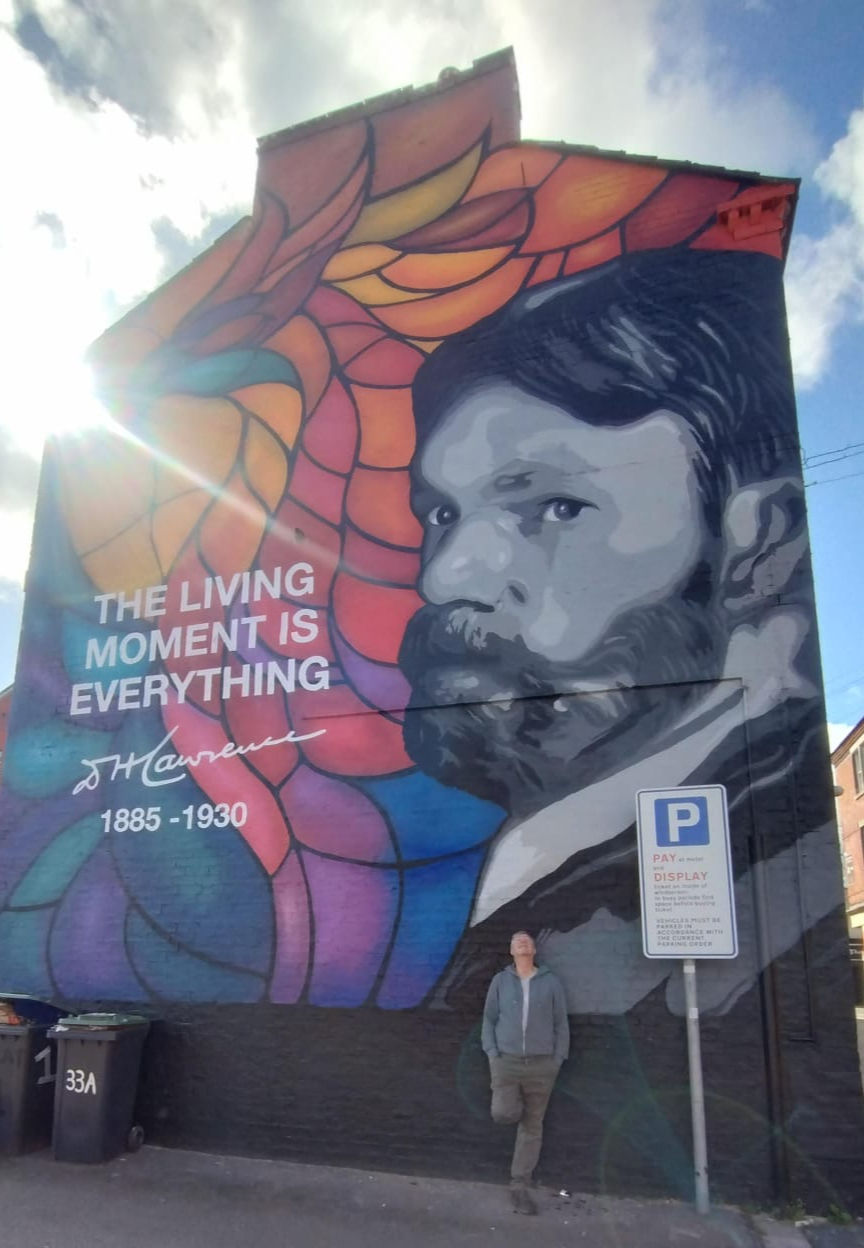
James at Eastwood. Mural designed & painted by artist Nathan Bainbridge (Small Kid/kid30) with help from Ben Packer.
The chosen quote Lawrence’s German wife Frieda was in awe of this element of his personality, writing in her memoir “to me his relationship, his bond with everything in creation was so amazing, no preconceived ideas, just a meeting between him and a creature, a tree, a cloud, anything. I called it love, but it was something else – Bejahung in German, ‘saying yes’”.
Bearing these principles in mind, I decided to create a video essay series on YouTube called Locating Lawrence which explores Lawrence’s letters for that month, a century from when they were written. In doing this, it has forced me to look more closely at his words and immerse myself in his life, such as sourcing appropriate images in the archives of Mabel Dodge Luhan at Yale and the Manuscripts and Special Collections at University of Nottingham.
Each video essay takes about a week to make from the reading and researching, to the writing and recording, to the editing and producing. The creative process means I am constantly reliving Lawrence’s words through different senses – listening, speaking, watching. It creates a kind of loop in time where I’m reliving that month’s letters over and over again until my own thoughts begin to blend with his and I begin to imagine how he must have felt. It’s immersion. It’s connection. It’s living the values he espoused.
Another reason Lawrence travelled the globe was his quest to find Rananim. He was seeking out a community of like-minded people who wanted to build a different world than the one responsible for war, industry and greed. He never found them, but that’s because there’s nobody quite like Lawrence. He called this quest his “savage pilgrimage”. My monthly video essays are a “digital pilgrimage”. They are an attempt to speak back to him. It’s a bit of a slow conversation, but at least it’s an interesting one. As Aldous Huxley once observed, “One of the great charms of Lawrence as a companion was that he could never be bored and so never be boring”. That’s certainly been my experience so far.
In our constantly connected lives, the days blur into each other without punctuation. Creating these monthly video essays acts as a kind of antidote to the immediacy of contemporary culture. They provide order and routine in an otherwise unpredictable and ever-changing world. But in March 2030, the centenary of Lawrence’s death, this nine-year project will come to an end. There will be no more letters to read. Best make the most of it now. We are all on borrowed time…
To watch the Locating Lawrence video essays, visit the YouTube channel ‘D.H. Lawrence: A Digital Pilgrimage here.
Subscribe to James’s Lawrence Substack ‘An absolute necessity to move’ here.
James Walker

About the Author James's previous projects exploring Nottingham's literary heritage include Dawn of the Unread, The Sillitoe Trail and Ai Up Mi Duck. He is currently working on a series of comics challenging stereotypes called Whatever People Say I Am and another Lawrence project called The D.H. Lawrence Memory Theatre. He is Course Leader for Creative Writing BA (Hons) at Nottingham Trent University.
More here https://www.ntu.ac.uk/staff-profiles/arts-humanities/james-walker This article/blog is published by Marysia Zipser, Founder & ACT Ambassador, Beeston, Nottingham. https://www.artculturetourism.co.uk/ https://www.artculturetourism.co.uk/blog
Please feel free to write your feedback, remarks/questions to James in the Comments box below, to which he will respond, and to share/forward this article/blog link to friends, colleagues and to socials as widely as you can. Thank you.
Useful Links:

D H Lawrence by Joe Ganech 2017 Brussels. Digital artwork.
Hi Patrizia,
Thanks for such a wonderful précis. I remember reading the letters of Philip Larkin when I was 18 and I sometimes wonder how different this type of project would have been if I had focussed on him instead. Larkin used to mow his lawn in a D.H. Lawrence T-Shirt which would make a great visual - the timid, tweed-wearing Hull University librarian and the bearded warrior...
I really like the parallel you make with the event in Ravenna, and the benefit of actively engaging with literature through dialogue. I hope I can make it to a future event. I have had the pleasure of hearing Nick Ceramella speak in Eastwood. He was discussing Sea and Sardinia, and brought…
James Walker's The Living Moment is Everything really sums up D. H. Lawrence’s whole persona. Studying his correspondence reveals his true character.
An absolutely inspiring read.
James Walker does not write an essay about D.H. Lawrence: he inhabits him. His project Locating Lawrence consists of reading, month by month, the six volumes of letters published by Cambridge University Press, following the calendar a century after they were written. Each video essay takes about a week of work, from research and writing to recording and editing. The result is a kind of slow conversation with a man who died in 1930, but who is kept alive by the very act of reading him every day.
What strikes the reader in the article is how Walker interweaves Lawrence's biography with his own. Both grew up in mining villages in Nottinghamshire — Walker in Cotgrave, Lawrence in Eastwood, nine…