


Updated: Feb 6
By Solman Nouman
Nottingham
22nd January 2026

On most Sundays, my four-year-old son and I find ourselves in our favourite little corner of Nottinghamshire, the charming grounds of the Nottingham Transport Heritage Centre at Ruddington. It has become something of a routine for us: a dose of steam-puffing fun, traditional transport history, and a chance to indulge our shared love of trains. When Marysia Zipser invited me to write for ACT, I knew exactly what I wanted to share, this delightful family outing that blends cultural heritage with Sunday fun.
Tiny Trains, Big Smiles
From 11 a.m. on most Sundays, the ride-on miniature steam trains begin their steady, excited rhythm. For just £1 per person per ride, you can hop aboard one of the beautifully kept engines and enjoy an experience that blends fun, nostalgia and heritage all at once. The Nottingham Transport Heritage Centre is run entirely by volunteers, whose time, care and enthusiasm help create this welcoming and affordable day out for families.
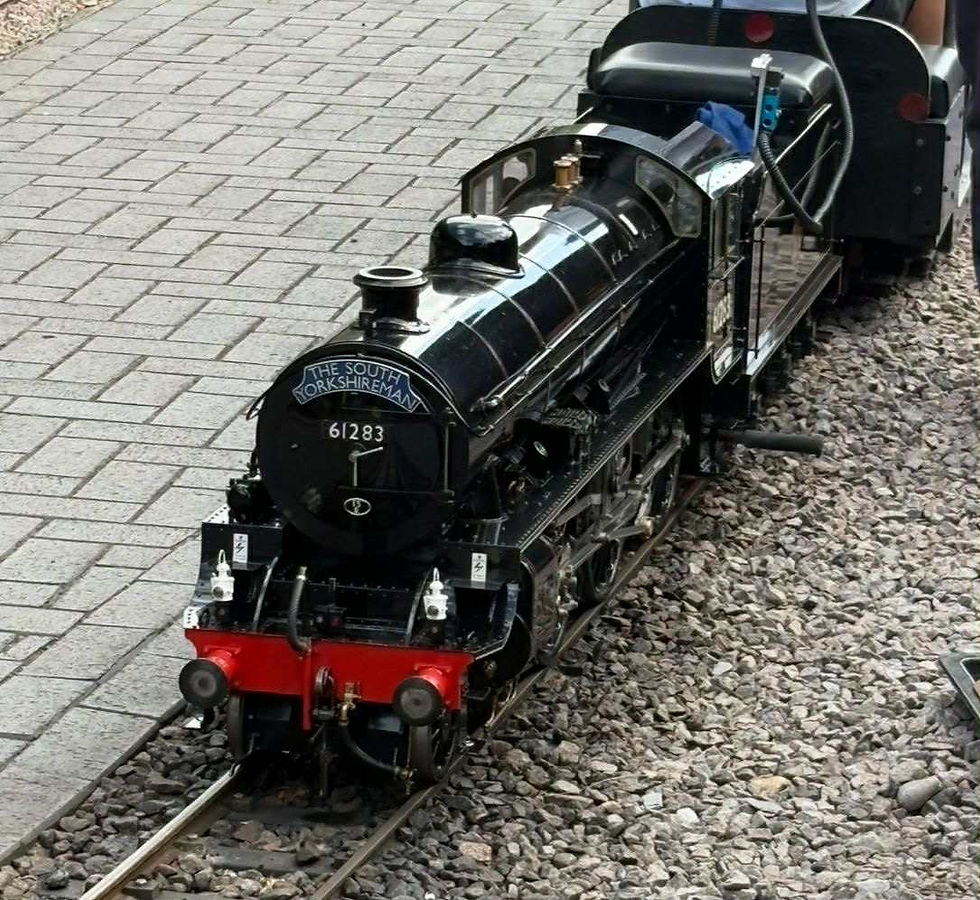
One of our favourites is The South Yorkshireman: immaculate in glossy black, proudly detailed and full of character. My son lights up every time he sees it.
The centre runs two operational tracks, which means more variety and fewer queues. You often hear the engines before you see them: the chuffing, the hiss of steam and the whistle that captures every child's attention instantly.
A Young Enthusiast's View

My son often stands at the fence, cap pulled low, waiting for the next train to emerge around the bend. Watching him in that moment, with small shoulders leaning eagerly forward, has become one of my favourite parts of our frequent visits.
The charm of the miniature railway is how real it feels to children. The platforms, the signals and the smell of steam all feel like the full-size railway world, just scaled down to their height.
Engines in Miniature, Live Steam in Action
Beyond the trains you can ride, the site regularly features live steam demonstrations. Mini traction engines puff and rattle their way around, each one proudly maintained by dedicated enthusiasts. These always pull in a curious crowd and one very excited four-year-old.
On cooler days, the plume of steam rises dramatically into the air and reminds you that these are real working engines, fired by coal and driven with skill.
Full-Size Heritage Too
The miniature tracks sit alongside the Great Central Railway (Nottingham) heritage main line platform. On special event days, especially around Christmas, the full-size trains roll in decorated with lights and festive spirit.

Seeing these classic trains up close adds a whole extra layer to the visit. It connects the miniature world to its full-scale origins and shows how the engines at child level relate to the history of rail travel.
Exploring the Whole Site
One thing I love about this place is that it is more than just trains. Around the grounds you will find:
Model railway layouts full of tiny details
Classic heritage buses, including local favourites connected with Trent Barton
A friendly café for a warm drink or snack
Enthusiasts and volunteers who are always willing to chat about engineering, restoration and history

Then there are the days when the miniature traction engines come out.
These engines are remarkable: built with precision, running on real steam and driven just like their full-sized ancestors.
My son even had the chance to sit behind one and enjoy a little trundle along the gravel. It is one of those memories I know we will both treasure for years.
Why We Keep Coming Back
As parents, we are always hunting for outings that feel meaningful. Not hurried, not overly commercial and not overwhelming. This place offers exactly that:
Affordable family fun (those £1 rides are hard to beat)
Hands-on heritage that you can see, hear and smell
Safe, open outdoor space where children can explore
Warm, welcoming volunteers who share their knowledge and passion
Something a little different each Sunday
Some days it is the engines. Some days it is the buses. Some days it is simply my son waving to the drivers as they steam past. Every visit has its own character.
Tips for First-Time Visitors
Arrive just after 11 a.m. if you want the quietest rides
Bring a camera, as the engines and platforms make great photos
Check for special events on the Great Central Railway website
Visit the café before you head home
Take time to walk around the whole site, not just the ride-on tracks
A Small Slice of Heritage With a Big Heart
In a world of big attractions and busy schedules, the Nottingham Transport Heritage Centre offers something refreshingly gentle. It is a place where engineering heritage meets childhood wonder, and where families can spend an hour or an afternoon simply enjoying themselves. Run by dedicated volunteers, it feels like a community as much as a visitor attraction.

Thank you again to Marysia Zipser for the invitation to share our story. I hope this inspires other families, railway enthusiasts or curious explorers to make their way to Ruddington on a Sunday and experience the magic for themselves.
We will be there, steam in the air and smiles all round.
Solman Nouman

Solman Nouman is a highly skilled and experienced Director of Finance and Operations, with more than a decade of leadership across the education, museums, and heritage sectors. He currently serves as Director of Finance and Operations at the Skills and Education Group, a leading Awarding Organisation (AO) with a proud legacy of social impact in education that dates back to 1912. In this role, Solman combines strategic financial leadership with operational oversight, supporting the organisation’s mission to widen access to education and skills development.
Alongside his work in education, Solman is Co-Director of NBA, a Nottingham-based archive hosted at Backlit Studios, where he helps preserve and promote cultural and historical material for future generations. His career began in the manufacturing industry, where he trained as a management accountant, building a strong foundation in commercial finance and operational efficiency.
Solman holds a first-class honours degree in BA (Hons) Accounting and Finance from Nottingham Trent University, reflecting both academic excellence and practical expertise.
Outside of work, Solman values family time above all else. He enjoys visiting railway heritage museums with his son, where they share a love of miniature steam trains, as well as the simple pleasures of ice cream and chips - a tradition that perfectly reflects his appreciation for heritage, community, and connection.
Useful Links:
https://www.gcrn.co.uk/ Great Central Railways (Nottingham) Ltd - official website for Nottingham Transport Museum Heritage Centre, Ruddington.
Nottingham Society of Model and Experimental Engineers (NSMEE): Features miniature traction engines and railway operations.
7¼” Gauge Society: An international organization for 7¼" gauge enthusiasts.
Sutton Coldfield Model Engineering Society (SCMES): Home to the Little Hay Miniature Railway.
Britain's Great Little Railways (BGLR): Represents leading narrow, miniature, and minimum gauge railways in the UK. https://www.visit-nottinghamshire.co.uk/
This article is published by Marysia Zipser, Founder & Ambassador of Art Culture Tourism & Keynote Speaker, Beeston, Nottingham. https://www.artculturetourism.co.uk/ https://www.artculturetourism.co.uk/blog E: artculturetourism@gmail.com
Please feel free to write your feedback remarks/reactions to Solman in the Comments box below to which he will respond, and to share/forward this article/blog link via email to friends, colleagues and to socials as you wish. Thank you.

Updated: Jan 11
By Janine Moore, Nottingham
9th January 2026
Why I felt inspired to write about Nottingham’s Queen Victoria Statue
The statue of Queen Victoria that stands today in Nottingham’s Victoria Embankment Memorial Gardens is one of the city’s most prominent civic sculptures. Executed in the high Edwardian manner by a noted public sculptor, the work has witnessed changing urban fashions and civic priorities: from its original prominence in the Market Square to its relocation beside the River Trent in the mid-twentieth century, and more recently to careful restoration and conservation. My inspiration to write about this particular sculpture came from understanding how public sculpture and art have a profound influence on us all in different ways. Through the ages, public access to art and sculpture has evolved; it is now much more widely available and certainly altered in shape and form. Yet, Queen Victoria continues to connect people, spreading hope, emotion, and creativity.
The Queen Victoria statue has endured many changes since its grand unveiling in Nottingham Market Square, vandalism, relocation and more recent renovation. She's looking amazing again, and she continues to give us hope and motivation. It’s this kind of impact that gave rise to the beauty of Joe Ganesh’s artwork, which I enjoyed viewing on Marysia Zipser’s living room wall. You will discover more of this story later in the article.

Queen Victoria statue in memorial gardens 2022. Photo credit Janine Moore
Photo credit Janine Moore
Commission and creation (c. 1903–1905)

The Queen Victoria statue in Nottingham was commissioned in the first years of the twentieth century as part of the city’s wider programme of civic commemoration following the passing of Queen Victoria in 1901. A local memorial committee engaged the sculptor Albert Toft (1862–1949), one of the foremost British sculptors of the period, to produce a dignified, figurative likeness in the literary-historic manner then favoured for royal effigies. Toft, trained at the Royal College of Art and widely practised in public monuments and portrait sculpture, brought to the Nottingham commission a well-established technical command of modelling and carving and a conservative but refined sense of monumentality. Albert Toft created three Queen Victoria statues; his earliest commission was in Leamington Spa and unveiled in 1902. Nottingham’s statue, unveiled in 1905, was Toft’s second Queen Victoria Statue, and in 1913, commissioned to create a bronze Queen Victoria statue that is mounted on a substantial granite pedestal in South Shields.
The Nottingham statue is carved from white marble and stands full-height on a square plinth of pink granite. The plinth is richly formed, featuring a cornice and stepped plinth, set upon an ashlar base and four steps; bronze relief plaques occupy three of the four faces and provide narrative and decorative accompaniment to the principal figure. Historical descriptions emphasise the quality of execution and the classical compositional restraint: the figure is stately and frontal, the royal attributes (crown, sceptre, robe) rendered with clarity rather than theatricality. The work was completed and prepared for public display in 1905.

The unveiling in Nottingham’s Market Place (1905)
The statue was publicly unveiled in Nottingham’s central Market Place in the summer of 1905.
Contemporary pictorial records and municipal sources indicate that the unveiling ceremony took place on 28 July 1905, an event of civic note that drew local dignitaries and was photographed for souvenir postcards and newspaper illustrations.

Winifred Anna Cavendish-Bentinck (1863-1954), The Duchess of Portland, DBE, JP, attended the unveiling of Queen Victoria as one of her extensive engagements. She was already established as one of the most influential aristocratic figures in Nottinghamshire at the time, humanitarian and animal welfare activist. As the wife of William John Arthur James Cavendish-Bentinck, 6th Duke of Portland, she resided at Welbeck Abbey, the historic ancestral seat of the Portland family.
The Market Place location and ceremonial unveiling situated the sculpture as a focal point of the city’s public life in the early twentieth century.
The choice of the Market Place conformed to late-Victorian and Edwardian civic instinct: to place a monarch’s effigy in a central commercial and social space signalled both loyalty to the Crown and an assertion of municipal dignity. As with many civic monuments of the period, the Nottingham committee sought a balance between public accessibility — a statue to be seen and used as a civic meeting point — and a sculptural language that communicated stability, continuity and imperial prestige.
[L] Winifred Cavendish-Bentinck, 6th Duchess of Portland, by P. A. de László, 1912. Welbeck Collection.
[R] Welbeck Abbey South East front
Mid-century reappraisal and relocation (1953)
By the mid-twentieth century, changing attitudes towards urban traffic, the reconfiguration of Nottingham’s Market Square and evolving ideas about the siting of memorial sculpture prompted a decision to reposition the statue. In 1953, the Queen Victoria statue was removed from the Market Place and re-sited in the Memorial Gardens on Victoria Embankment beside the River Trent. The move reflected multiple practical and symbolic considerations: urban redevelopment and traffic management in the city centre made the Market Square less congenial as a site for a large, fixed monument; at the same time the Memorial Gardens — laid out in the interwar period as Nottingham’s civic remembrance landscape — provided a contemplative, green setting where commemorative sculpture and the war memorial could stand together in a designed composition. Municipal records and subsequent historical summaries note the 1953 transfer without extensive published commentary on the logistical operation itself; still, the relocation placed the statue in a setting intended for reflection rather than as a busy meeting point.
Physically, the move required careful handling. Marble statues of this size are heavy and brittle, and their pedestals and bronze plaques compound the logistical complexity. Although detailed archival records of the lifting, packing and transport are not widely published, mid-century municipal practice typically involved temporary crating, specialist handling by stone and removal contractors, and the construction (or re-use) of an appropriate granite plinth at the new site. The Memorial Gardens installation aligned the Queen Victoria statue with the War Memorial terrace and the cross-shaped ornamental pond, integrating royal commemoration within a broader civic memorial scheme.
Queen Victoria Statue post renovation in Memorial Gardens, Nottingham. Photos credit Janine Moore
Condition, vandalism and twentieth-century conservation
Over the decades, the statue suffered the normal effects of weathering and, at times, vandalism. Local accounts from the late twentieth and early twenty-first centuries record loss of small elements (notably some fingers and the sceptre), surface soiling and patination of the bronze reliefs. In recognition of the Memorial Gardens’ importance and the listed status of the statue (designated Grade II on the National Heritage List), the city secured funding and contractor expertise for a significant conservation intervention completed and publicly re-unveiled in October 2022 as part of a larger £1.1–1.7 million restoration of the Victoria Embankment Memorial Gardens. The work carried out by Lindum Group included cleaning and re-pointing of the plinth, steam and hand cleaning of the marble, repair and re-carving of missing sculptural details (the sceptre, for instance, was re-carved from Italian marble by specialist stone workers), and conservation of the bronze plaques. The restoration returned the figure to a condition more faithful to Toft’s original modelling and restored the legibility of the relief panels.
Historic England’s listing record (first entered in 1972) recognises the statue’s architectural and historic interest: the work is noted as an example of early-twentieth-century public sculpture by a prominent sculptor, and its association with Nottingham’s civic development (Market Place prominence and later incorporation into the Memorial Gardens) is explicitly recorded. The listing also documents the statue’s materials, pedestal composition and the presence of relief plaques, making the listing an essential reference for ongoing conservation and management.
Iconography and public meaning
Albert Toft’s portrayal of Queen Victoria is intentionally restrained and formal. The iconography — crown, sceptre, robes, urn-like forms in relief — conforms to the language of monarchy as dignified, paternal and continuous. In its original Market Place setting, the statue functioned as a statement of civic loyalty and imperial belonging; once moved to the Memorial Gardens, it acquired an additional commemorative resonance, harmonising royal memory with the city’s war memorial landscape. The re-siting can therefore be read as both a practical response to urban change and as a re-framing of the statue’s significance: not only an emblem of monarchy but also an element within a civic programme of remembrance.
Joe Ganech Artistic Interpretation Unveiling at City Council House in November 2017
Marysia: I would like to tell you the story of the intervening years of 2017 and 2018 and how artist Joe Ganech tells us, weaving and unfolding another story of the Queen Victoria statue and creating his own interpretation.
Please see the Notts TV clip here of 27 November 2017 of the unveiling of ‘Queen Victoria - Complete’ canvas at Nottingham Council House, Members Room, by The High Sheriff of Nottinghamshire, then Colonel David R Sneath. Attended by the Sheriff of Nottingham, then Councillor Glyn Jenkins and Tim Pollard, ‘Robin Hood’, with translator, artist and photographer friends.
Also, please see the reel produced by Caron Lyon of PCM, of her take on the webcast event (she was our ACT events & digital producer 2016-2019), seeing more of the Council House and Members Room.
Photographer Ray Teece, who created the Nottingham in Photographs website created 2006 http://www.nottingham21.co.uk/, tells his own story with his photographs of the events in Nov
2017 and March 2018. http://www.nottingham21.co.uk/misc_queen_victoria_complete_1.htm

Joe was one of our ACT-represented artists during 2016-2018, who loved our Nottingham historical figures and places, using iconography and symbolism for his digital artworks. Joe is Spanish (speaks several languages), and lives in Brussels. So for the unveiling, Caron organised a webcast showing him live online to our Nottingham and global audience. Joe had spotted the Queen Victoria photograph by Ray and said he’d like to do an artwork of it, and while he was liaising directly with Ray, I asked Joe whether he could insert a new digital sceptre to replace the one broken and removed. At that time, the statue was looking pretty forlorn and neglected, wanting a clean-up, so Joe added those vital colours to bring it alive.
These videos can also be accessed via https://www.artculturetourism.co.uk/videos. Scroll down to ‘Load More’ and click.
Moving on to March 2018. Joe Ganech visited Beeston and Nottingham for a second time. His first exhibition was for the ACT International Artists exhibition in April 2017 in Nottingham. This time for an ACT exhibition at The Hive gallery, Beeston, Nottingham city centre artists' group tour and Ghost Bus event (at Chilwell Arts Theatre) together with several ACT international artists visiting during the same week. It was also an opportunity for Joe to actually meet Ray Teece in person. Joe was able to sign his canvas and prints at The Hive with Ray present, and also to meet and talk with Colonel David Sneath at Nottinghamshire County Council’s County Hall at Trent Bridge. So I arranged a photoshoot by Ash Wroughton, taking shots of them both on the grand staircase there. So the story of the ‘Queen Victoria - Complete’ canvas could continue onto the printed pages of the Nottingham Post.

Conclusion
Public sculpture occupies a unique and powerful position in the cultural landscape of cities and towns, and communities worldwide. Far from being mere decoration, public sculptures are a visible embodiment of collective memory, civic identity, and cultural values, shaping not only the aesthetic quality of urban environments. They bridge communities, cultures and shared histories and collective futures.
The availability of public sculpture is integral to the visual and spatial identity of cities and towns worldwide. They give a sense of civic pride and give urban spaces a feel of character and public cohesion. Democratic accessibility to art needs to be a pivotal part of the planning process when re-purposing or creating public spaces. Sculptures and other public artworks act as a stimulus for discussion, creating common ground where strangers meet, pause, converse and share interactions.
The psychological and well-being benefits of engaging with public art have been associated with improvements in mental well-being. Sculptures and artistic installations offer moments of pause in the pace of urban life, providing visual respite and enhancing emotional experience in ways that transcend functional spatial design.
The Queen Victoria statue in Nottingham exemplifies the life cycle of civic sculpture in modern Britain: conceived as a public embodiment of loyalty and municipal pride, executed by a sculptor of national standing, made prominent in the city’s busiest square, then recontextualised mid-century as urban form and memory evolved. Its Grade II listing, its successful conservation and its ongoing placement in the Victoria Embankment Memorial Gardens together ensure that the statue remains an accessible and legible part of Nottingham’s urban and commemorative fabric. For those interested in the statue itself, the Historic England listing, local archival images of the 1905 unveiling, and contemporary conservation accounts provide complementary documentation of its artistic and civic biography.

Photo Credit Janine Moore
Principal sources consulted (selection)
Historic England, List Entry: Statue of Queen Victoria in Memorial Gardens (Grade II listing).
Picture Nottingham (Nottingham City Museums photographic archive), Queen Victoria’s Statue, Market Place, 1905 (unveiling images and caption).
Local press and council project reports on recent conservation works and the 2022 re-unveiling (MyNottinghamNews, Nottstv, Lindum Group).
Cast in Stone / academic databases and sculptor biography material on Albert Toft.
Janine Moore

Janine Moore is a Nottinghamshire-based writer and blogger with a passion for uncovering the stories hidden within England’s landscapes, heritage sites, and walking experiences. Drawing on years of exploring historic estates, charming towns, and countryside trails, she loves to share her experiences of travel, history, and hearty food in a way that’s both informative and inviting.
Living in the heart of Nottinghamshire, Janine is perfectly placed to explore some of England’s most captivating regions. From the romantic ruins and rugged beauty of the Peak District—one of her favourite places to roam—to the legendary Sherwood Forest and the elegant halls of historical properties, she approaches every journey with a storyteller’s curiosity and a photographer’s eye. Janine is Deputy Editor of ACT blog.
Janine also writes for the www.baldhiker.com website as their heritage and countryside writer, covering walks, food and heritage subjects. https://www.baldhiker.com/author/janine-moore/
Janine’s most recent blog post for Art Culture Tourism International. https://www.artculturetourism.co.uk/post/dale-abbey-ruin-hermit-s-cave-and-the-whispering-woods-of-depedale 25.10.25
Please read Marysia and Janine's blog post about Welbeck Abbey and the Harley Foundation to discover more about the Duchess of Portland's family homestead.
This article is published by Marysia Zipser, Founder of Art Culture Tourism & ACT Ambassador, Nottingham, UK. https://www.artculturetourism.co.uk/blog https://www.artculturetourism.co.uk/
Please feel free to write any remarks to Janine (and Marysia) in the Comments box below and to share this article via email and social links as you wish. Thank you.
Useful links: