


By Roland 'Roly' Keates
Derbyshire
10th July 2026
For two days I travelled through Latvia searching not simply for castles, churches, or old towns, but for something quieter and older still, something rooted deep within the forests, songs, and memory of the land itself. The journey began unexpectedly after a member of a Latvian pagan community discovered my Custodians of the Woodland video blogs on YouTube and invited me to experience Latvia through the eyes of those who still feel connected to its ancient traditions.

Satezele Hill fort
As someone who spends much of his own life wandering the woodlands of Derbyshire, filming fires beneath trees, speaking about folklore, old beliefs, and the relationship between people and landscape, I felt an immediate pull toward the invitation. Latvia carries a reputation unlike almost anywhere else in Europe, because beneath its churches, roads, and modern cities there still survives an undercurrent of Baltic pagan memory. It survives not as a staged reconstruction, but through midsummer fires, dainas sung beside woodland clearings, sacred groves, folklore, and in the way many people still speak of nature as though it possesses spirit, personality, and presence.
Again and again I was told that if you wish to feel the deepest echoes of this older Latvia, you must travel west toward Kurzeme, the ancient land of the Curonians, where forests, coastlines, rivers, and hill forts still seem to whisper of a pre-Christian worldview that never entirely vanished.

My own journey began in Riga before dawn, the city still hushed beneath a pale Baltic sky. As the roads carried me outward into the countryside, the modern world slowly loosened its grip. Villages became smaller and more scattered.
Forests deepened around the roadsides. Birch trees lined the landscape in silver and green, while marshland, meadow, lakes, and woodland seemed woven together into one continuous breathing landscape.
Latvia feels profoundly different from much of Western Europe. The land itself appears less conquered somehow, less divided from memory.
As I drove further into the countryside, I found myself lowering the car windows simply to hear the wind moving through the trees. It reminded me of why I began Custodians of the Woodland in the first place, that need to step away from noise and rediscover places where silence still carries meaning.

By mid morning I reached Pokaiņi Forest, one of the places most strongly associated with Latvia’s spiritual and pagan atmosphere. The woodland is famous for its mysterious groupings of stones scattered across low hills and winding woodland paths.
Some believe the stones hold healing energy, while others see the forest as an ancient ritual landscape connected to ancestral worship and earth spirituality. Archaeologists remain cautious about many of the mystical claims, yet standing there among the stillness of the trees,
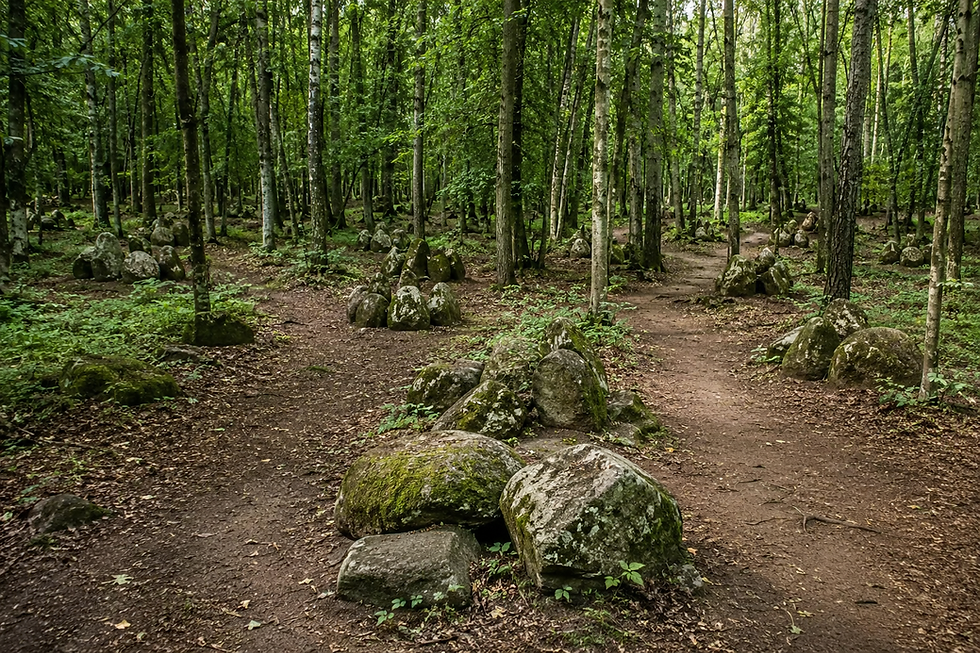
Pokaini Forest, one of the Places most closely associated with Latvia's spiritual and pagan atmosphere. The woodland is famous for its strange groupings of stones scattered across low hills and winding paths.
It became easy to understand why people are drawn to the place. Pokaiņi did not feel theatrical or commercialised. It felt deeply quiet, almost listening. I walked slowly beneath the canopy, passing moss covered stones warmed by shafts of sunlight breaking through the branches above. Birds moved quietly through the woodland while the wind carried that soft hush which seems to exist only in old forests untouched by hurry.
There were moments when the place felt less like a destination and more like a threshold between worlds. Latvia’s spirituality often appears rooted not in grand temples or formal ceremony, but in relationship with land, fire, silence, and continuity. Pokaiņi embodied that perfectly.

Pakiani Forest trees
Later that afternoon I travelled south toward Tērvete Nature Park, another landscape deeply woven into Latvian mythology and folklore. Tērvete is associated with the ancient Semigallian tribes and appears throughout old folk memory and legends. The woodland there carries an atmosphere that feels almost dreamlike.

Tall pines surrounded the pathways while the ground rolled gently through shadows and patches of golden light. At times I genuinely felt as though some figure from folklore might emerge quietly between the trees.
As somebody deeply drawn toward mythology, druidic traditions, and sacred landscape myself, I found the place profoundly moving. It reminded me how stories are often born directly from landscape, from rivers, forests, caves, and hills that leave an emotional imprint upon the human imagination.
As evening approached I joined a small fire gathering where traditional Latvian songs known as dainas were being sung softly beside the woodland edge by people connected with the modern pagan revival movement called Dievturība.

A small fire gathering where Latvian songs, known as dainas, were being sung softly by local people connected with
the modern pagan revival movement known as Dievturiba
The songs carried themes of ancestors, seasons, sunlight, farming, rivers, and ordinary daily life. On the surface they seemed simple, yet beneath that simplicity sat immense emotional depth and continuity. Sitting there beside the firelight listening to those voices rise gently into the darkening forest, I began to understand how Latvia preserved so much of its older worldview.

These traditions were never entirely separated from ordinary life. They remained connected to family, land, memory, and seasonal rhythm rather than becoming confined solely within institutions or museums.

Watching the flames move beneath the Baltic night sky, I found myself thinking of my own fires back home in Derbyshire woodland, and how across Europe people once gathered in similar ways beneath trees, carrying stories, songs, and reverence into the darkness.
The second morning carried me north toward Sigulda and the Gauja Valley, often described as one of Latvia’s most spiritually resonant landscapes. The Gauja River cuts through forests, sandstone cliffs, caves, and rolling hills, creating scenery steeped in folklore and ancient memory.
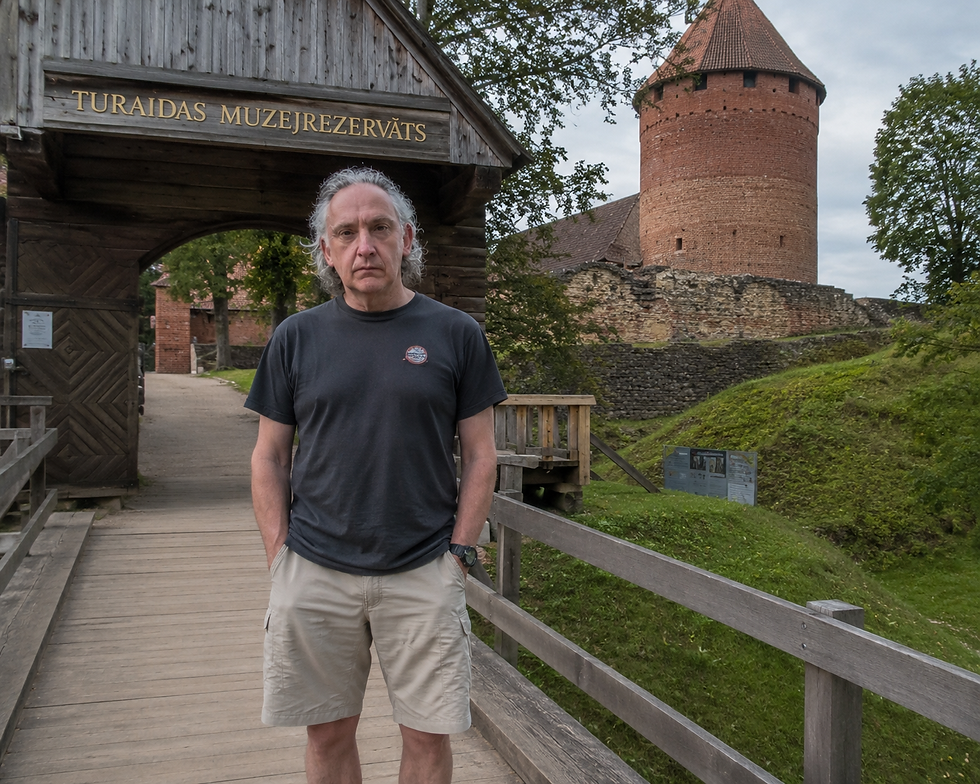
Turaida Castle
I visited Turaida Castle Hill, where medieval stone ruins now stand upon land that likely carried sacred significance long before Christianity arrived. Across Europe many pagan sacred places eventually became sites for castles, churches, monasteries, or fortifications, and here you could almost feel the layers of history resting one upon another.

Early morning hike overlooking the Gauja Valley
Standing upon the hill looking out across the Gauja Valley, mist drifted slowly between endless forests while pale sunlight touched the river below in soft gold. The atmosphere felt deeply reflective, almost inward. Latvia’s spirituality feels less ceremonial than much modern paganism. Instead it feels woven into continuity, into midsummer fires, oak wreaths, rivers, songs, and the turning of seasons themselves.

Getting ready for Jani, Latvia's midsummer celebration
Again and again people spoke of Jāņi, Latvia’s midsummer celebration where fires burn through the shortest night of the year and ancient customs continue almost unchanged from pre-Christian times. Even outside festival season, you could sense its presence everywhere. The land itself seemed orientated toward cycles of growth, darkness, renewal, and return. It reminded me strongly of older druidic ideas surrounding sacred landscape, thresholds, and humanity’s place within nature rather than above it.
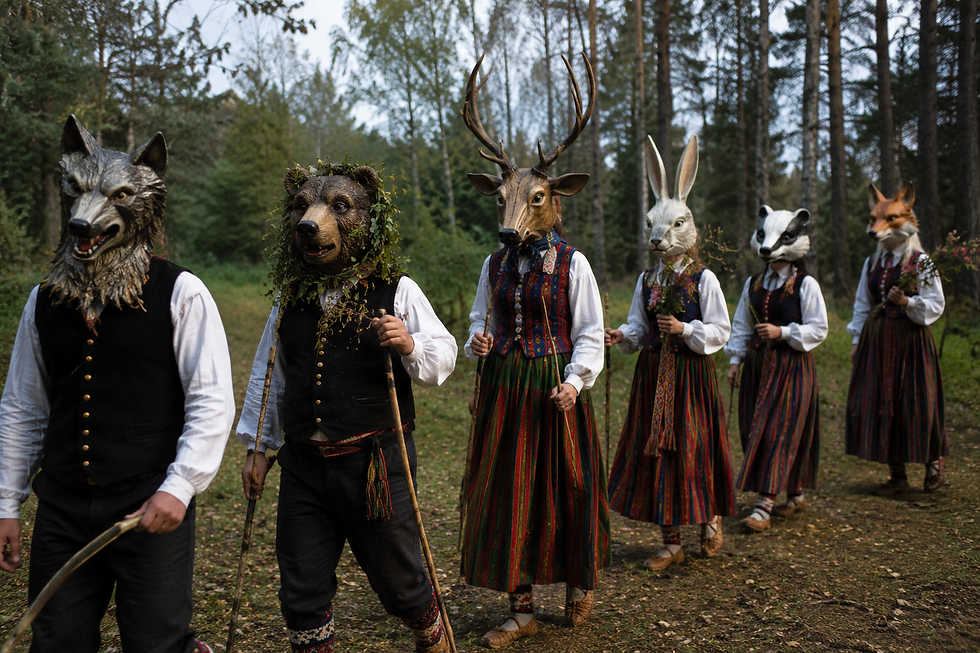
Wearing masks of their totem animals
By the end of those two days I realised Latvia’s pagan spirit is not confined to one sacred grove or single historical site. It exists in fragments scattered gently across the country. In forests like Pokaiņi. In songs carried through generations. In hill forts, rivers, fires, and quiet rural communities where old customs still breathe beneath the modern world. Most of all it exists within the relationship between people and landscape itself. Latvia does not merely preserve echoes of the old Baltic world. In many places, it still quietly lives beside the modern one.

Returning to normality
As I finally turned back toward Riga beneath fading evening light and endless forest horizons, I carried with me the feeling that I had briefly encountered something Europe once understood almost everywhere, but has largely forgotten. A spirituality rooted not in domination over nature, but in belonging within it.
Please keep watch on my YouTube channel as I share how I experienced life through the forests, sacred landscapes, fires, songs, and ancient spirit of Latvia, seen through the eyes of a Custodian of the Woodland.
Roland 'Roly' Keates

About the Author
Roland “Roly” Keates is a Derbyshire-based filmmaker, photographer, and historian whose work explores the intersections of place, memory, and light. A long-time documentarian of local heritage and sacred landscapes, he is the creator of the Custodians of the Woodland film series and Look Up to Derby, a visual journey through the city’s architecture.
Blending fine-art photography with historical research, Roly’s projects often weave together themes of spirituality, craft, and the enduring presence of the past within the English landscape.
His work has been exhibited regionally and featured in collaborative community projects across art, culture, and heritage. When not filming or editing, he can usually be found wandering woodland paths, camera in hand, waiting for the perfect meeting of light and story.
He is the Creator of the Custodians of the Woodland film series: https://www.youtube.com/playlist?list=PLr7M_vks5PajZ71vLjXNpTgEKR9Nbi4LG
Useful Links:
Roland 'Roly' Keates aka Lost Histories https://www.youtube.com/channel/UCDfS5FR9XCVxSMB-V4Q7iTw
This article is published by Janine Moore, Deputy Editor, and Marysia Zipser, Founder & ACT Ambassador, Beeston, Nottingham. https://www.artculturetourism.co.uk/ https://www.artculturetourism.co.uk/blog E: artculturetourism@gmail.com
Please feel free to write your feedback, remarks/reactions to Roly in the Comments box below, to which he will respond, and to share/forward this article/blog link via email to friends, colleagues and to socials as you wish. Thank you.