


Updated: Sep 23
By Solman Nouman & Maya Yates
Nottingham
24th September 2026
At Nottingham College's historic Adams Building, a Heritage Open Days collaboration between Skills and Education Group, Boots UK, CPMG Architects and Nottingham College brought more than a century of education, industry, architecture and social change into one shared story.

Heritage Open Days champions and colleagues outside Nottingham College's Adams Building on Saturday 12 September 2026. Photo supplied by Skills and Education Group.
There are buildings that preserve history, and there are buildings that continue to make it. On Saturday 12 September, Nottingham College's Adams Building did both. During Heritage Open Days 2026, visitors stepping through its Stoney Street doors encountered a free exhibition that connected Nottingham's industrial past with a much longer story about education, employment and the people who have worked to widen opportunity.
Opening Doors: The Extraordinary Impact of Everyday Education Heroes was created through collaboration between Skills and Education Group, Boots UK, CPMG Architects and Nottingham College. Together, the partners brought different aspects of Nottingham's story into one place: the city's lace and manufacturing heritage, the development of workplace learning, the growth of vocational and technical education, the importance of architecture and adaptive reuse, and the continuing role of colleges, employers and awarding organisations in helping people progress.
Rather than treating heritage as a collection of dates and objects, the exhibition posed a more human question: who opened a door for somebody else? Through photographs, reports, historic equipment, digital material, guided tours and hands-on activity, the answer emerged in many forms. It could be a teacher, an employer, a welfare pioneer, an examiner, a training organisation, a college or simply an individual prepared to create an opportunity that did not previously exist.
A building that carries its history
The setting was central to the story. The Grade II* listed Adams Building stands in the heart of Nottingham's Lace Market. Commissioned by Quaker industrialist and philanthropist Thomas Adams and his business partner James Page, the building’s construction began in 1854 and continued in phases until around 1874. At the height of Nottingham's lace industry, the building operated as a major warehouse and clearing house, where lace produced across the region was finished, displayed, packaged and prepared for buyers around the world.
Today, this historical building is a place of learning. Nottingham College uses its historic spaces for programmes including fashion and textiles, with students working in original lace lofts where industrial heritage and contemporary creative education sit side by side. That continuity made the Adams Building an especially powerful venue for an exhibition about the relationship between skills and work. A building once dedicated to production is now helping new generations develop the knowledge and craft that will shape their own working lives.
Guided tours on the day allowed visitors to look beyond the exhibition cases and experience the building itself as part of the archive. CPMG Architects, whose connection with the Adams Building stretches back almost three decades, brought an architectural perspective to the wider collaboration and to the idea that historic buildings can remain useful, relevant and alive through thoughtful adaptation.
A century of opening doors
For Skills and Education Group, the event also opened up an archive that tells a story stretching back more than a century. The organisation traces its roots to the East Midland Educational Union, formed in 1912 to bring education authorities and teaching institutions together, expand technical, art and continuation education, and provide examining and certification routes for learners. Its early work grew from a practical problem: people needed credible routes into learning and employment, but those routes were uneven, fragmented and too often shaped by class and circumstance.
One of the most evocative items on display was the East Midland Educational Union's 1911-1912 annual report. Its worn cover and fragile pages are unassuming, but the document records the beginnings of an infrastructure that would go on to support generations of learners. Other items, including historic prospectuses and an Edwardian certificate press, showed how formal recognition of learning became part of that infrastructure. A certificate might appear to be ‘just’ a piece of paper, but for a learner it could represent proof of knowledge, a step into employment or the confidence to continue studying.
The early twentieth-century display placed the East Midland Educational Union's 1911-1912 annual report alongside wider social history, linking education and skills to the context of the period. | A post-war newspaper article asked a question that still feels strikingly current: how should young people be prepared for a changing labour market? Photos supplied by Skills and Education Group. |
Another display used post-war newspaper material to explore anxiety about youth employment. One headline asked, 'Is Post-war Youth To Be Workless?' Another warned of growing numbers of young people competing for fewer jobs. The language belongs to a different age, but the underlying concern is familiar. How do communities make sure ability is not wasted? How do education and industry respond when the economy changes? And who takes responsibility for building the bridge between learning and work?
The exhibition did not suggest that today's challenges are identical to those of the past. It showed something more useful: debates about skills, access and opportunity recur, and every generation has to decide how seriously it will respond.
Workplace learning and the Boots story
The Boots Archive presented a parallel history of learning through work. Boots is one of Nottingham's and perhaps the country's most recognisable names, but its heritage is not only a story of retail and manufacturing. It is also a story of welfare, training and continuing education. In 1913, the company introduced free educational provision for employees through evening classes delivered with Nottingham's Education Committee, reflecting a belief that employment and learning could reinforce one another.
Archive photographs displayed at the exhibition brought that philosophy into view. A 1920s image of Boots Beauty Advisors attending a training course in Nottingham captured the practical reality behind the policy. These were people developing skills for a changing industry, and the photograph helps connect the language of today's workforce development with a much older local tradition of employers investing in knowledge, confidence and progression.

Archive image displayed at the exhibition: Boots Beauty Advisors attending a training course in Nottingham in the 1920s.
The image formed part of the Boots Archive contribution to Opening Doors.
Placed alongside the Skills and Education Group material, the Boots archive made an important point. Education does not happen only in classrooms, and employment is not simply the destination at the end of learning. For more than a century, Nottingham's institutions have repeatedly blurred those boundaries through apprenticeships, evening classes, vocational qualifications, workplace training and professional development.
Turning archives into an experience
The strongest heritage events allow people to do more than look. Opening Doors combined traditional archival displays with digital flip books, film content, interactive activities and guided tours. Visitors could get up close to examine documents, explore a timeline from the early twentieth century to the present day and handle the physical equipment once used to certify achievement.
The certificate press was a particular reminder of how much ceremony and material craft once accompanied formal recognition. Displayed alongside a modern press, it offered a simple visual comparison between past and present. Technology changes, but the symbolic value of recognition remains: somebody has learned something, demonstrated it and had that achievement acknowledged.

Photo supplied by Skills and Education Group.
For families and casual visitors as well as dedicated heritage enthusiasts, this mix of objects and activity made the archive accessible. The exhibition was not designed only for people who already knew the history of further education, qualifications or Nottingham's industrial institutions. It was designed to invite curiosity, and to give visitors multiple ways into the story.
The people behind the exhibition
That sense of invitation was made possible by substantial behind-the-scenes work. Fragile archive material had to be researched, selected and interpreted. Displays needed to work for a broad public audience. Cases were prepared, equipment installed, captions written, digital material tested and visitor routes coordinated with the wider Heritage Open Days programme at the Adams Building.
Yasmin Nutt, Robyn Whalley and Emma Thompson co-curated the exhibition, with colleagues and Heritage Open Days champions from across the partner organisations contributing research, archive expertise, event planning, interpretation, tours and visitor engagement. The collaboration also drew on the work of Maya Yates, Sophie Clapp, Richard Thorpe, Solman Nouman, Eliza Gilbert, Natalie Westwood, Monica Watson, Benito Sansone and Sophie Jepson, alongside many others who helped bring the day to life.

Contributors to the exhibition were recognised for the part they played in bringing the story to the public.
This was one of the project's clearest strengths. Each organisation brought a different lens. Skills and Education Group contributed the history of qualifications, assessment and access to learning. Boots brought the perspective of a major Nottingham employer with a long tradition of staff development. Nottingham College provided both the historic venue and the living continuation of vocational education within it. CPMG Architects connected the story to the built environment and to the value of preserving historic places through continued use.
Why the story still matters
The exhibition title deliberately focused on 'everyday education heroes'. Heritage can easily become a story dominated by famous names, landmark dates and grand institutions. Those things matter, but education changes lives through quieter acts too: a tutor who encourages a learner to continue, an employer that creates a training route, a qualification that provides credible evidence of someone's skill, a college that keeps a specialist craft alive, or an organisation that recognises a barrier and works to remove it.
That is also why the exhibition felt contemporary. Social mobility, youth employment, access to education and the changing skills needs of employers remain live issues. The details are different from 1912 or the post-war years, but the central challenge remains recognisable: talent is widely distributed, while opportunity is not. Institutions make a difference when they turn good intentions into practical routes that people can actually use.
For cultural tourism, there is another lesson. The most memorable heritage experiences do not isolate the past from the present. They help people understand why a place looks the way it does, how communities were shaped, and what has been carried forward. At the Adams Building, visitors were not simply shown what Nottingham once made. They were invited to consider what Nottingham made possible - through education, employment, enterprise and the repeated reinvention of its buildings and institutions.
A shared Nottingham story
By the time the exhibition closed, the archive cases and banners had done more than mark a single Heritage Open Days event. They had placed education and skills more firmly within Nottingham's cultural story, alongside lace, architecture, retail, design and industry. They also demonstrated what can happen when organisations with different histories stop telling their stories separately and begin looking for the connections between them. This narrative resonated with visitors who engaged with the archive, and many brought their own memories of working life at Boots, educational experiences, and how, though times had changed, many of the core themes have not.
Nottingham is rightly proud of its famous buildings, businesses and industries. Opening Doors offered a reminder that the city's history is also found in the less visible infrastructure of opportunity: the evening class, the training course, the examination, the certificate, the workshop, the tutor, the employer and the learner willing to take the next step.
Those stories deserve to be preserved because they explain more than where we have come from. They challenge us to think about the doors we are opening now - and who will be able to walk through them in the years ahead.
Solman Nouman, Director of Finance & Operations & Maya Yates. Senior Marketing Manager,
of Skills and Education Group.
https://www.skillsandeducationgroup.co.uk/ Boots Archive:
Nottingham College:

By James Walker
Nottingham 11th September 2026
I grew up in a mining village five miles southeast of Nottingham called Cotgrave. It was the eighties, meaning an unquenchable desire for violence permeated the streets. A combination of Thatcherism, unemployment, and strikes split the community into warring tribes who swore allegiance to their Union banners. Everyone was thoroughly unhappy with their lot until they found temporary solace in a pint, which, invariably, led to more fights.
D.H. Lawrence (1885-1930) grew up in the mining village of Eastwood, nine miles northwest of Nottingham. His father, Arthur, worked as a Butty at nearby Brinsley Colliery and was a charismatic tyrant who would be harshly depicted in Sons and Lovers (1913). Mining culture would feature heavily in Lawrence’s early works, including three plays, as well as dialect poems such as ‘The Collier’s Wife’. Through these he would develop one of the key themes in his writing; the dehumanising effects of industry and the “ugliness” it wrought in men.
I couldn’t wait to escape Cotgrave and left home at sixteen. I lived in various cities across the UK before eventually - inevitably – being lured back to Nottingham. Lawrence left Britain in 1919 and travelled as far away from the Midlands as he could get. He crossed continents and countries, living in America, Mexico, Australia, with regular dalliances across Europe. He was seeking out alternatives to the “ugliness” of his childhood, and found solace in remote locations, such as a ranch in the mountains above New Mexico or close to the sea in Sicily.
Lawrence was completely restless, never living in the same place for more than two years. Why limit yourself to one place when you could have the world? “The east seems to me the world to meditate in, Europe the world to feel in, America the world to act in”, he would observe. But nowhere was ever good enough. It was as if he was fuelled by disappointment, writing, “I’ll see this damned world, if only to know I don’t want to see any more of it.” Geoff Dyer describes him as “manic to the point of frenzy” whereas Catherine Carswell takes his wanderlust a step further, suggesting he “disliked an air of everlastingness about a home. For him it must have something of the tent about it”.
This restlessness fascinates me, particularly given how difficult and slow it must have been to travel the globe before Google Maps and cheap airlines. What’s more, Lawrence was multilingual. When he wasn’t penning his own novels, he was translating the works of Russian and Italian authors. And there was me getting excited because I was on a 57-day streak on Duo lingo.
He wasn’t just an incredible writer; he was an incredible human being. In my desire to learn more about who he was as a person, I turned to the six volumes of his letters published by Cambridge University Press and began reading them each day, a century from when they were written. Unlike his novels, which can go on a bit at times, his letters are pithy, poignant, and very funny. For example, in August 1926 he was in Scotland dismayed at the Grouse shooting which was ‘an event for those that shoot, and a still bigger one for those that get shot’.
Lawrence travelled extensively for a variety of reasons, not least his health. It was almost as if he feared siting still would allow the tuberculosis he vehemently denied having to catch up with him, as it finally did in March 1930.
To keep moving onwards, he had to be continually dissatisfied with his current lodgings, believing the next place would be better. He became a giant strop on legs, claiming to be ‘inexhaustibly displeased’ with each new location. One of his most scathing, yet self-aware letters, comes from Ceylon on 5 April 1922.
“I loathe the tropical fruits, except pineapples, and those I can’t digest: because my inside has never hurt me so much in all my 36 years as in these three weeks. I need this bitterness, apparently, to cure me of the illusion of other places.”
But his attitude towards place is best summed up in a letter to the poet Amy Lowell. On arriving at his latest destination, he offers the non-committal “I hesitate here”. It is no surprise, then, that he refused to own property. I, on the other hand, was desperate to lay down roots as I became a parent at twenty. A mortgage represented security and a freedom of sorts. Lawrence, who never had children, was only interested in routes, and continually fantasised about his next location. The purpose of travel was movement. It had nothing to do with destination. This is evident when he became so disillusioned with the solid world that he made plans to live on a boat, claiming to be “landsick” and that “the solid ground almost hurts”.
Although Lawrence was constantly on the move, he believed passionately in immersing yourself in the present, of being connected to your immediate environment and the thing that you’re doing now. As he warned in his poem ‘Transmitters’, “As we live, we are transmitters of life / And when we fail to transmit life, life fails to flow through us.”
Earlier this year, a giant mural of Lawrence appeared on a house close to his Birthplace Museum in Eastwood.
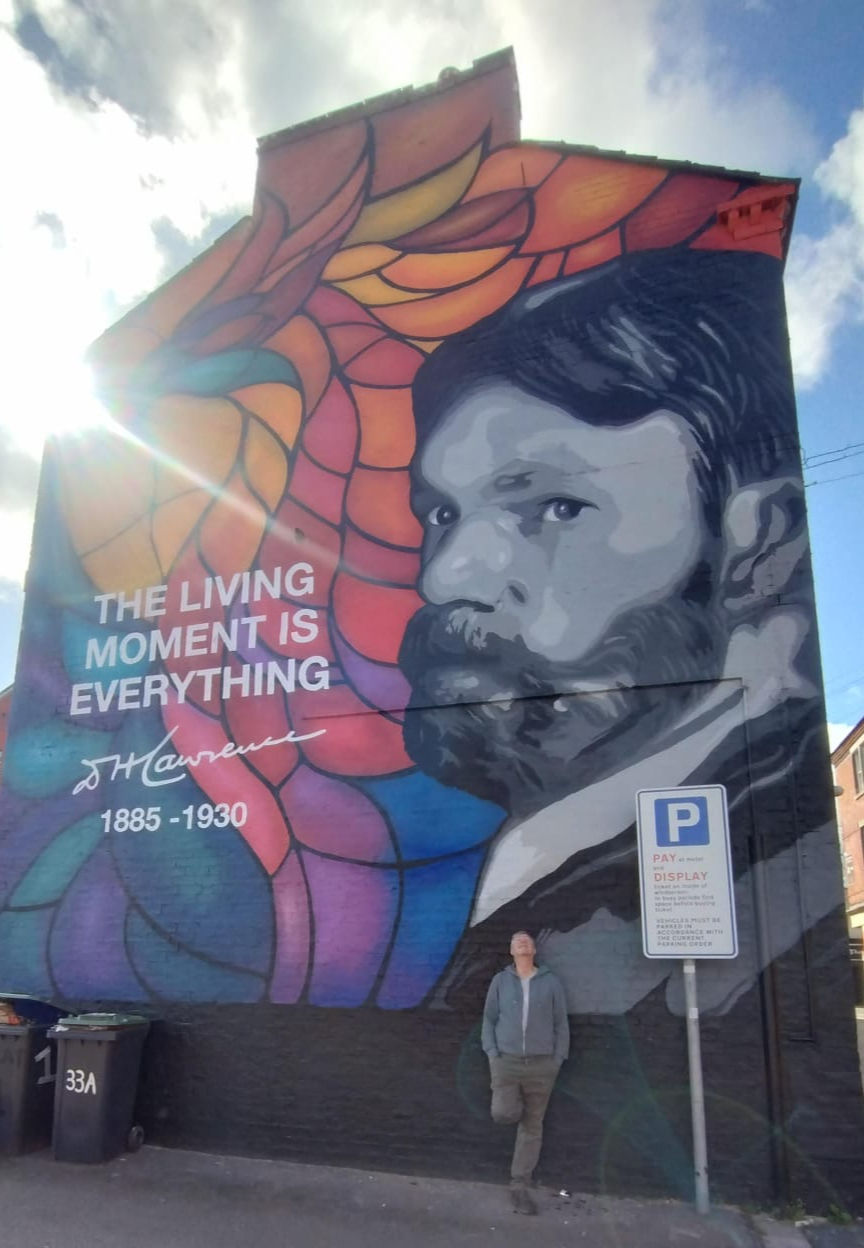
James at Eastwood. Mural designed & painted by artist Nathan Bainbridge (Small Kid/kid30) with help from Ben Packer.
The chosen quote Lawrence’s German wife Frieda was in awe of this element of his personality, writing in her memoir “to me his relationship, his bond with everything in creation was so amazing, no preconceived ideas, just a meeting between him and a creature, a tree, a cloud, anything. I called it love, but it was something else – Bejahung in German, ‘saying yes’”.
Bearing these principles in mind, I decided to create a video essay series on YouTube called Locating Lawrence which explores Lawrence’s letters for that month, a century from when they were written. In doing this, it has forced me to look more closely at his words and immerse myself in his life, such as sourcing appropriate images in the archives of Mabel Dodge Luhan at Yale and the Manuscripts and Special Collections at University of Nottingham.
Each video essay takes about a week to make from the reading and researching, to the writing and recording, to the editing and producing. The creative process means I am constantly reliving Lawrence’s words through different senses – listening, speaking, watching. It creates a kind of loop in time where I’m reliving that month’s letters over and over again until my own thoughts begin to blend with his and I begin to imagine how he must have felt. It’s immersion. It’s connection. It’s living the values he espoused.
Another reason Lawrence travelled the globe was his quest to find Rananim. He was seeking out a community of like-minded people who wanted to build a different world than the one responsible for war, industry and greed. He never found them, but that’s because there’s nobody quite like Lawrence. He called this quest his “savage pilgrimage”. My monthly video essays are a “digital pilgrimage”. They are an attempt to speak back to him. It’s a bit of a slow conversation, but at least it’s an interesting one. As Aldous Huxley once observed, “One of the great charms of Lawrence as a companion was that he could never be bored and so never be boring”. That’s certainly been my experience so far.
In our constantly connected lives, the days blur into each other without punctuation. Creating these monthly video essays acts as a kind of antidote to the immediacy of contemporary culture. They provide order and routine in an otherwise unpredictable and ever-changing world. But in March 2030, the centenary of Lawrence’s death, this nine-year project will come to an end. There will be no more letters to read. Best make the most of it now. We are all on borrowed time…
To watch the Locating Lawrence video essays, visit the YouTube channel ‘D.H. Lawrence: A Digital Pilgrimage here.
Subscribe to James’s Lawrence Substack ‘An absolute necessity to move’ here.
James Walker

About the Author James's previous projects exploring Nottingham's literary heritage include Dawn of the Unread, The Sillitoe Trail and Ai Up Mi Duck. He is currently working on a series of comics challenging stereotypes called Whatever People Say I Am and another Lawrence project called The D.H. Lawrence Memory Theatre. He is Course Leader for Creative Writing BA (Hons) at Nottingham Trent University.
More here https://www.ntu.ac.uk/staff-profiles/arts-humanities/james-walker This article/blog is published by Marysia Zipser, Founder & ACT Ambassador, Beeston, Nottingham. https://www.artculturetourism.co.uk/ https://www.artculturetourism.co.uk/blog
Please feel free to write your feedback, remarks/questions to James in the Comments box below, to which he will respond, and to share/forward this article/blog link to friends, colleagues and to socials as widely as you can. Thank you.
Useful Links:

D H Lawrence by Joe Ganech 2017 Brussels. Digital artwork.