


By Janine Moore
Nottingham
9th October 2026
Some places hold history in their stones, and others hold us. If you travel just a few miles north of Nottingham, following the dipping lanes through the rolling countryside, you will find Southwell. Tucked away like a well-kept secret, this market town doesn’t shout for attention. But as you round the final bend, the horizon is suddenly claimed by the magnificent, lead-capped towers. This is Southwell Minster - The Cathedral Church of Nottinghamshire.

To a photographer, it is an absolute dreamland of shifting light, deep textures, and soaring geometry, and deciding whether to use black and white to give the stone masonry a better structure in the shot or to use colour to show the stunning stained glass windows in their truest detail. To the historian, it becomes a living textbook. And to anyone else who steps through its heavy timber doors, it seems to become something much deeper: an oasis of true, uninterrupted peace.
Whether you come with a deep religious faith or with a love for ancient craftsmanship, you will find within these doors, or if you simply desire to escape the frantic rush of modern life, the Minster opens its arms to you. It is a sanctuary for everyone.

The Historic Tapestry of Southwell Village
To understand the Minster, you must first understand the soil from which it grew. The story of Southwell (often pronounced "Suth-ell" and correctly pronounced South-Well ) is intimately bound up with the waters that gave it its name. Historically, the area was defined by its numerous natural springs—the "wells" of the south—which have drawn people to this sheltered valley for thousands of years.
Way back before the first stone of the current church was laid, Southwell was a bustling hub of Roman life.
During the 1st to 4th centuries AD, a gigantic, luxurious Roman villa stood on the very ground where the Minster now rests. This wasn't just a simple farmstead; it was a grand estate complete with an extensive bathhouse complex and intricate, multi-coloured mosaic floors.
When standing in the Minster yard today, did you know that you are walking directly over the footsteps of Roman citizens who looked out across these same Nottinghamshire fields seventeen hundred years ago?
The Roman past still lingers in the fabric of Southwell; it offers us a tangible link to our earliest roots.
By the Anglo-Saxon era, King Edgar of England established a collegiate church here in 956 AD. Southwell became a vital administrative and religious heart for the Archbishop of York, transforming the quiet village into a thriving medieval market town. It would have been absolutely bustling at this time.
Walking down the historic Burgage or exploring the beautifully preserved prebendal houses that frame the Minster today, you can still feel that distinct medieval layout—a peaceful village built to support, and be supported by, a magnificent house of stone.

A Sanctuary For All
Buildings of this scale can sometimes feel intimidating or clinical, but Southwell Minster has a rare, uniquely domestic warmth. It is a place that embeds itself into your personal geography.
Many share a lifelong relationship with this building, and I first experienced it as a volunteer on a school trip: the sound of children echoed off the high stone vaults, and the children's eyes lit up in awe of the cathedral's vastness and intricate details.
Years later, I returned with my family and showed them all the details: the carved faces hiding in the rafters, the beauty of the carved natural elements in the leaves.
And then, of course, there are the quiet afternoons spent with dear friends—the kind of visits where very few words are spoken, because the space itself invites a reflective, comfortable silence.

Personal Reflection
When I walked through the nave with my longtime friend Marysia, Southwell Minster became a backdrop for shared life stories. It is a place where you can sit side-by-side on a wooden bench, watching the dust motes dance in the shafts of afternoon sun, feeling entirely grounded and at ease.
The deep personal connection highlights the Minster’s truest purpose: it is an entirely inclusive space, and that is one of the elements that I love about Southwell. It is entirely irrelevant whether you subscribe to a particular liturgy, follow a different faith, or hold no spiritual beliefs at all. The atmosphere is completely democratic.
The silence here doesn't demand piety; it simply offers rest, for instance. It is a communal living room for the soul, built by hands long dead to comfort the living. In my mind, this is the most inspiring and heartwarming aspect of Southwell Minster.

Echoes of Empire: The Roman Legacy Within the Stone
One of the most thrilling aspects of the Minster is its architectural multi-layering. It is a building constructed from the recycling of history.
If you know where to look, the Roman foundations speak directly to you. During excavations in the 1950s, fragments of a beautifully preserved Roman tessellated pavement—a mosaic floor of tiny squares of red, white, and blue-grey stone—were uncovered beneath the south transept floorboards.
The Roman presence isn't just hidden beneath your feet; it was actively absorbed into the walls. When Norman builders arrived in 1108 AD to construct the massive church seen in Southwell today, they didn't just quarry fresh stone from nearby Mansfield; they dug into the ruins of the abandoned Roman villa.
Look closely at some of the interior walls and lower archways, and you will spot distinctive, flat red Roman tiles and bricks layered into the stone masonry. These ancient materials were repurposed by Norman masons, meaning that the very physical fabric of the Minster is a literal bridge connecting the classical world of the Roman Empire to the medieval world of Christian Europe.
Master Builders: The Soul of the Stone Masonry Architecturally, Southwell Minster is divided into two distinct halves: the heavy, muscular Norman nave and the breathtakingly light Gothic choir and chapter house. This transition showcases some of the finest stone masonry in all of Europe.
The Norman Nave
The nave is an absolute triumph of Romanesque design. As I walked down the central aisle, I was flanked by the massive, circular stone pillars that felt as permanent as tectonic plates.
The arches above them are thick, semi-circular, and adorned with bold, geometric chevron patterns.
The masonry here is all about power, scale, and symmetry. The tool marks of the 12th-century masons are still visible on the Magnesian Limestone - broad, confident strokes of the axe that give the stone a tactile, hand-hewn quality.
The light here is low and moody, pooling around the bases of the pillars and casting long, dramatic shadows. It is a paradise for high-contrast black-and-white photography.


The breathtakingly detailed 'Leaves of Southwell' carvings Carved into the capitals of archways and doorways is the world-renowned artwork known as the Leaves of Southwell. These are not stylized, rigid medieval patterns; they are breathtakingly accurate, deeply undercut botanical portraits of the English countryside.
Masons carved the stone directly from the pure beauty of nature, capturing the fluid, organic lines of oak leaves complete with tiny, individual acorns.
With dedication, they captured the details of creeping ivy and delicate wild roses, maple, hawthorn, and buttercups. If you pay attention to the smaller, special pieces, there are hidden forest creatures and green men peeking through the foliage.
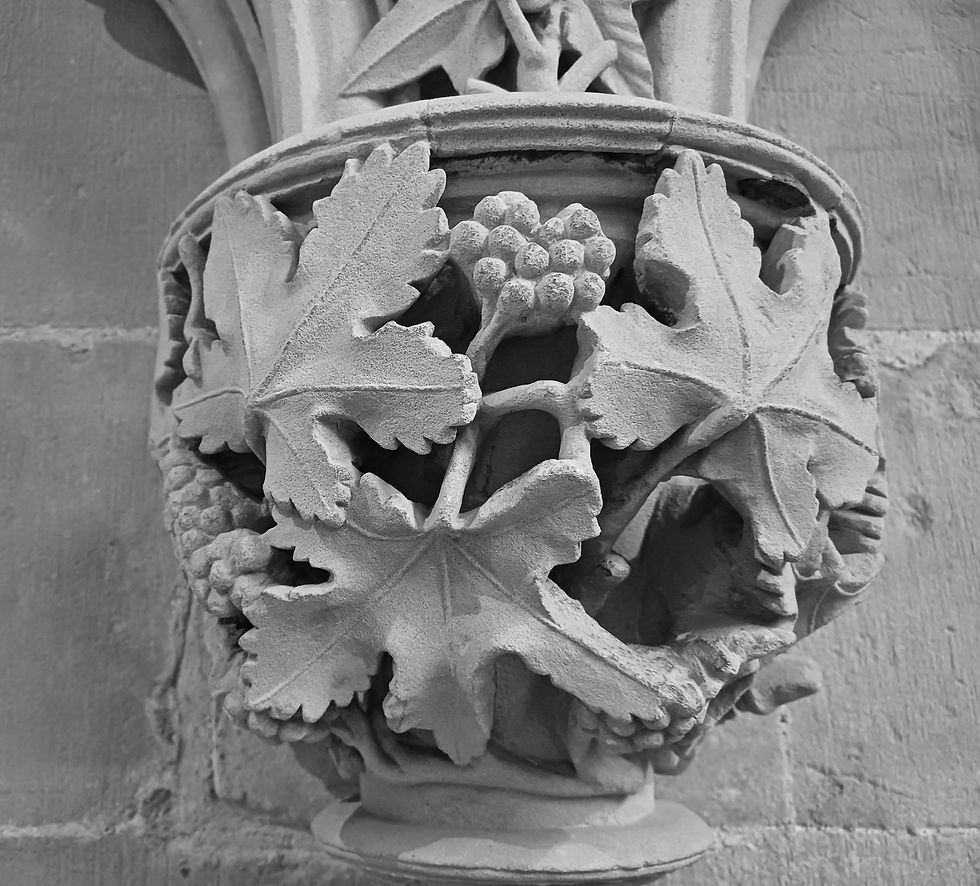
The undercut is so deep that you can slip your fingers completely behind some of the stone leaves, making it feel all the more real.
When the morning light spills through the windows, it catches the delicate edges of these stone carvings, casting intricate leaf shadows across the walls. It actually feels as though an ancient Sherwood Forest has been permanently petrified into a state of graceful, eternal spring. You have to experience it for yourself to appreciate it fully.
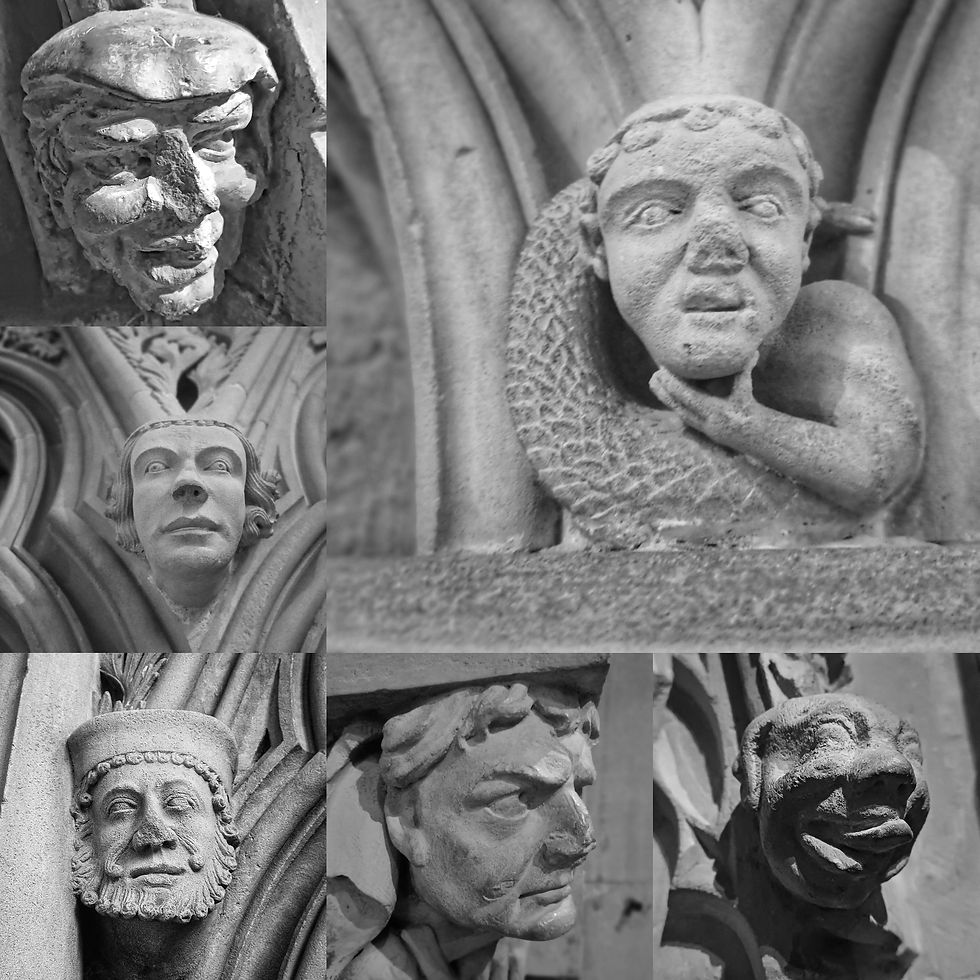
A Book Quote From 'Nottinghamshire' by Roy Christian
Quoted from page 153: "It is the naturalness of the carvings that catch the eye. These were surely the work of men who, like Thomas Hardy, ‘noticed things’, the work perhaps of local men from Sherwood Forest who knew about nature. And they knew, too, about people. The heads round the chapter are surely real people, probably the workmen themselves. There is the master mason, and a man with toothache. There are similar heads on the slightly later choir screen: a man pulling at his beard; another scratching his leg. You get the feeling that the men who did these carvings were happy in their work, and some of that happiness must surely have been transmitted to generations of later visitors."

The Beauty of the Stained Glass
The stone masonry provides the bones of Southwell Minster, and therefore the stained glass windows are undoubtedly its shifting, luminous soul. The glass pieces are a vibrant patchwork compiled across different centuries, telling stories not just through their imagery, but through the very evolution of glass-making technology.
Window Location Historical Era Visual Style & Characteristics
Great West Window, 15th-century Perpendicular, massive architectural grid filling the nave with clean, geometric afternoon light. The Great West Window at Southwell Minster. Often called The Angel Window. Designed by renowned British artist and glass painter Patrick Reyntiens. Created in collaboration with Barley Studio in York. Installed in 1996 to celebrate the centenary of the diocese. Featuring a gathering of hundreds of fluidly sketched angels holding roundels, each of the days of creation or other significant biblical scenes.
The Choir Lancets, 13th-century (Original French Glass): Deep, saturated jewel tones smuggled out of Paris during the French Revolution; intense blues and rubies.
Modern Windows: 20th & 21st-Century Contemporary Abstract, fluid designs by artists such as Patrick Reyntiens and Nicholas Mynheer splashing vibrant, dynamic colour across ancient stone.
The experience of the glass changes entirely depending on the time of your visit. On a crisp autumn morning, the high, narrow lancet windows in the East End project long, intense beams of ruby red and sapphire blue deep into the choir stalls. These particular pieces of glass have a wonderfully interesting history. There is 13th-century French glass, originally from the Church of the Holy Innocents in Paris, brought to England for safety during the turmoil of the French Revolution. The depth of their colour is unmatched; modern techniques still struggle to replicate the rich, uneven density of this medieval "pot metal" glass.

In stark contrast, the Great West Window dominates the back of the nave. Added in the 15th century, its soaring, vertical stone tracery holds larger, much clearer panes. As the sun begins to set, this window acts as a giant lens, drinking in the amber and gold of the dying light and flooding the massive Norman columns with a warm, copper glow.
It’s a real joy for the photographer to see how light flows differently throughout the day. No matter when you visit, you will find the perfect shot.

A Blueprint for a Peaceful Visit
To truly absorb the unique, meditative spirit of Southwell, it helps to approach your visit not as a checklist of sights, but as a slow journey of the senses. Here is a thoughtful way to structure an afternoon of quiet exploration:
The Approach
I recommend you start your visit to Southwell Minster by walking through the historic town center, stopping for a quick coffee in a local courtyard, where there are many quality cafes I have sampled. Walk along the Minster's outer boundary wall to appreciate how the pale Mansfield stone shifts in colour from a cold grey under clouds to a rich, buttery gold when the sun breaks through.
The Threshold
When I entered through the north porch, I paused for a moment in the massive, cool air of the Norman nave. Then I listened as the ambient sounds of the outside world instantly dropped away, replaced by an expansive, velvety silence. It brings such a soul-calming atmosphere.

The Stone Trail
Walk slowly down the north aisle; keep your eyes sharp for the flat red Roman tiles embedded in the masonry work.
If you walk towards the crossing beneath the stone pillars, you will feel the immense vertical scale of the structure.
The Sanctuary
Spend time alone in the Chapter House. Sit on one of the stone seats beneath the Leaves of Southwell. Turn off your camera, put away your phone, and simply watch how the changing daylight catches the delicate stone veins of the carved oak and ivy leaves. When I have visited previously with family or with my good friend, Marysia, we have always taken moments to sit and pause to take in the feeling of sanctuary.
The Farewell
Finish your visit in the Palace Gardens just outside, walking among the ruins of the old Archbishop's Palace, from where the ancient lawns offer a beautiful view back up at the soaring towers.

Location and Address
Southwell Minster
Church Street,
Southwell,
Nottinghamshire,
NG25 0HD
Parking
The closest car park is on Church Street and has 90 spaces. NG25 0HQ
King Street car park has 50 spaces, NG25 0EW
The Bramley Centre car park is behind the Library and has 25 spaces. NG25 0EJ
An Ever-Open Door
Southwell Minster remains a real tribute to what human beings can achieve when they pour their patience, artistry, and spirit into a single, collective goal across centuries. I have always greatly admired the stonework and carpentry on every visit. It is a monument constructed from Roman ruins, shaped by Norman ambition, and softened by Gothic poetry. Yet, its greatest achievement isn't its historical pedigree or its architectural fame. Its greatest achievement is its persistent, unshakeable kindness.

Long after you have left its grounds - after you have said goodbye to family, parted ways with friends, or finished your latest photography project - the memory of that deep, cool interior peace stays with you. It stands as an enduring reminder that we all need spaces to slow down, to breathe, and to connect. And the doors at Southwell remain open, waiting quietly to welcome anyone who seeks a moment of calm in our beautiful, changing world.
All photography by Janine Moore.
Further reading:
Nottinghamshire, a book by Roy Christian.
Useful Links;
What's on at Southwell Minster, Cathedral church of Nottinghamshire: https://www.southwellminster.org/whats-on/
Southwell Minster - The Association of English Cathedrals:
Southwell Workhouse, an article by Janine Moore on the BaldHiker website:
Janine Moore
Janine Moore is a Nottinghamshire-based writer and blogger with a passion for uncovering the stories hidden within England’s landscapes, heritage sites, and walking experiences. Drawing on years of exploring historic estates, charming towns, and countryside trails, she loves to share her experiences of travel, history, and hearty food in a way that’s both informative and inviting.

Living in the heart of Nottinghamshire, Janine is perfectly placed to explore some of England’s most captivating regions. From the romantic ruins and rugged beauty of the Peak District—one of her favourite places to roam—to the legendary Sherwood Forest and the elegant halls of historical properties, she approaches every journey with a storyteller’s curiosity and a photographer’s eye. Janine is Deputy Editor of ACT blog.
Janine also writes for the www.baldhiker.com website as their heritage and countryside writer, covering walks, food, and heritage subjects. https://www.baldhiker.com/author/janine-moore/
Janine’s most recent blog post for Art Culture Tourism International, 9th January 2026 .https://www.artculturetourism.co.uk/post/queen-victoria-statue-nottingham-how-public-sculpture-plays-a-pivotal-role-in-society
This article is published by Marysia Zipser, Founder of Art Culture Tourism & ACT Ambassador, Nottingham, UK. https://www.artculturetourism.co.uk/blog https://www.artculturetourism.co.uk/
Please feel free to write any remarks to Janine in the Comments box below and to share this article via email and social links as you wish. Thank you.